

The fascist meaning is simple: a fascist is a person who supports fascism, a far-right ideology that builds on extreme nationalism, a single all-powerful leader, and the crushing of opposition. In addition, people use the word as an adjective for anything that resembles that system. In everyday speech, however, it often carries a looser meaning: someone who controls others harshly or refuses to tolerate disagreement.
First, here is how to say it: FASH-ist (sometimes FAS-ist). Also, it works as both a noun and an adjective.
What Is the Fascist Meaning?
In its strict, historical sense, a fascist follows fascism, the movement that took power in Italy in the early 1920s. For example, dictionaries describe fascism as a system that puts the nation, and often race, above the individual. In this system, a dictatorial leader holds central power, the state controls business and society, and opposition has no place.
As a noun, it therefore means a supporter of that ideology. As an adjective, on the other hand, it means “relating to or resembling fascism,” such as fascist propaganda or a fascist regime.
Fascist Meaning at a Glance
The table below shows how the word compares with related terms.
| Term | Type | Simple Meaning |
|---|---|---|
| Fascist | Noun / Adjective | A supporter of fascism, or something relating to it |
| Fascism | Noun | The ideology or system itself |
| Fascistic | Adjective | Having the traits of fascism |
| Authoritarian | Adjective | Demanding strict obedience to authority |
| Totalitarian | Adjective | A state that controls nearly every part of life |
Fascist Meaning and Origin: Where the Word Comes From
The word comes from the Italian fascista, which grew out of fascio, meaning “bundle” or “group.” In turn, fascio goes back to the Latin fasces, a bundle of rods tied around an axe. Roman officials carried it as a symbol of authority and strength through unity.
Later, Benito Mussolini’s movement adopted the symbol and the name around 1919, and fascist soon entered English. In fact, the first recorded English use dates to 1919, while fascism followed in 1921. Then the movement took power in Italy in 1922, and that period gave both words the meaning we use today.
Key Characteristics of Fascism
Scholars still debate an exact definition. However, historians such as Robert Paxton and writers such as Umberto Eco point to features that appear again and again.
Extreme Nationalism
First, the nation comes before everything else. As a result, loyalty to it outranks personal rights and freedoms.
A Single Powerful Leader
Next, one figure holds all the authority and claims to embody the nation.
Suppression of Opposition
Moreover, the regime restricts or bans rival parties, free press, unions, and open criticism.
Control of Society and Economy
In addition, the state directs business, labor, education, and public messaging, often through propaganda.
Glorification of Force
Finally, fascist movements celebrate violence, military strength, and national “rebirth.” Furthermore, they usually blame an enemy group, inside or outside the country.
Fascist vs Nazi vs Authoritarian
These words overlap, but they do not mean the same thing.
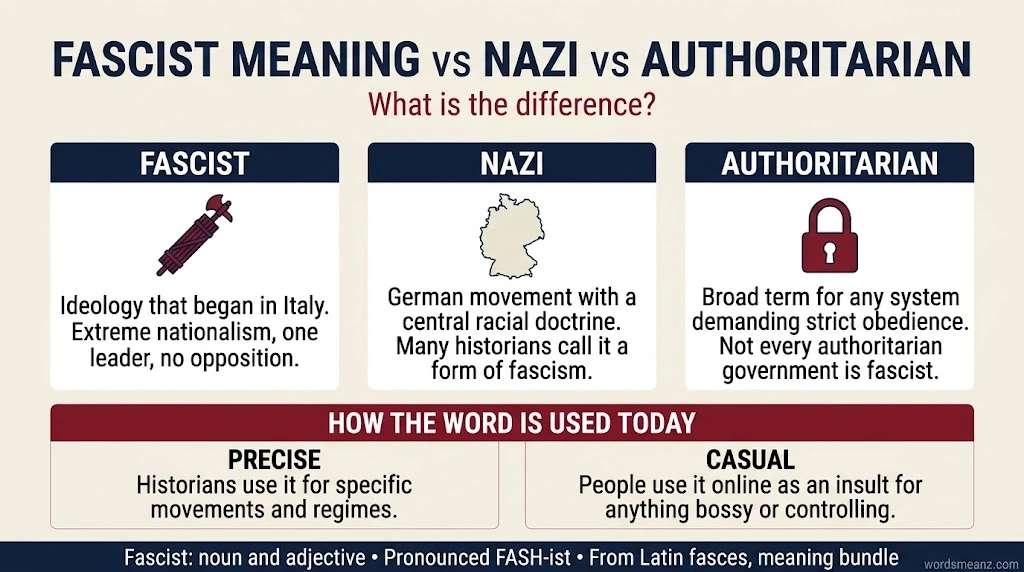
- Fascist refers to the ideology that began in Italy. Besides that, people use it as a broad category for similar movements.
- Nazi refers specifically to the National Socialist movement in Germany, which added a central racial doctrine. Still, many historians call Nazism a form of fascism, although they also discuss the differences.
- Authoritarian is a wider term for any system that demands obedience. Therefore, not every authoritarian government counts as fascist.
How the Word “Fascist” Is Used Today
Today, people use the word in two very different ways.
1. The precise meaning. Historians and political scientists apply it to specific movements and regimes that match the traits above. Thus, in this sense it works as an exact label.
2. The casual or insulting meaning. Online and in heated arguments, however, people often throw “fascist” at anyone or any rule that seems bossy, controlling, or intolerant. For instance, someone might call a strict teacher or a rigid dress code “fascist” in a casual way. Many dictionaries note this figurative use. In addition, some editors point out that the word now often works as a catch-all insult.
Online insults also spread fast, much like other internet slang. If you enjoy decoding how political labels turn into memes, read our guide to the chud meaning, another loaded term that travels well beyond its original context. Similarly, people hate feeling left out of trends, and that same pull explains why words like this spread so quickly. Our FOMO meaning article explores that feeling.
Examples of “Fascist” in a Sentence
Here are four ways to use the word:
- “Historians study how fascist movements rose to power in Europe in the 1920s and 1930s.”
- “The documentary explains the fascist symbols that propaganda used.”
- “He called the new rule ‘fascist,’ but critics said the word was too strong.”
- “Fascist ideology rejects democracy and individual freedoms.”
Why Understanding the Word Matters
Words like fascist carry heavy history. Therefore, using the term accurately keeps conversations clear. In contrast, using it loosely weakens its meaning and makes real discussion harder. As a result, knowing the difference helps you read news, history, and online debate with more confidence. Similarly, big questions about language and purpose shape how we think, and we explore them in what is the meaning of life.
Frequently Asked Questions
What is the simple meaning of fascist?
A fascist supports fascism, a system with a dictator-style leader, extreme nationalism, and no tolerance for opposition.
Is fascist an insult?
It can be. Used precisely, it works as a historical and political label. However, in casual speech people often use it as an insult for anyone who seems overly controlling.
Where does the word fascist come from?
It comes from the Italian fascista and fascio (“bundle”), which in turn come from the Latin fasces, a bundle of rods that symbolized Roman authority.
What is the difference between fascist and Nazi?
Fascism began in Italy, while Nazism was the German movement centered on racial ideology. Although many see Nazism as a form of fascism, the two are not identical.
Is fascist a noun or an adjective?
Both. As a noun, it means a supporter of fascism. As an adjective, however, it means relating to or resembling fascism.
Final Thoughts
In short, a fascist, in the true sense, supports fascism, a nationalist, leader-centered ideology that rejects opposition and began in Italy. However, people stretch the word far beyond that in daily life, so context decides whether it works as a precise historical term or a casual jab. Meanwhile, if you want more word breakdowns, try our ASMR meaning guide, or explore the curious spiritual side of numbers in our 555 angel number meaning article.
Finally, you can verify the official definition in the Merriam-Webster entry for fascist. Overall, knowing the fascist meaning helps you read political language with more confidence.
[…] than the dictionary definition. Words have more meaning than they might seem to, such as fascist. Others started as quick text slang, like SMH and FOMO. If you’re the type who looks for […]
[…] backed Italian fascism during WWII. If you don’t know what fascist means, our discussion of what fascist means will help […]
[…] to “ruckus” than anything sinister. With loud sounding words context is important. The word fascist has a lot of meaning in the political field and bangarang is only a loud and playful […]
[…] and songs work the same way. If you enjoy decoding the real meanings of words, our fascist meaning guide does the same thing for a heavy word that people use too […]
[…] Some will simply float along, like ethereal. Others tend to carry big political baggage. Read our guide to the word fascist and explore how its meaning can change and become more […]
[…] is not a mood nor a temperament, it is a political ideology and a form of government. We have a fascist meaning guide for that meaning. However, it is not a political term to say a writer has a controlling […]
[…] to examine the consequences of such dogmatic certainty in the political realm, our guide to the meaning of fascism and its history will explain what it […]
[…] retain their roots for thousands of years. Interested in following a word back to its origins, our fascist meaning guide traces a Roman bundle of rods to its political […]
[…] there’s a light teasing tone to the word. It doesn’t sound severe, whereas some words such as fascist have strong political […]
[…] mean? If you stumbled upon the term in an online heated debate, you’ll find out from our fascist meaning guide. If you are seeing a text that you’re thinking, “SIGHHHHH,” our SMH meaning […]
[…] path. They first link to one area and time, and then people begin to use them in a larger way. The fascist meaning guide shows another word that spread beyond its first […]
[…] of one specific political movement, but today people stretch it to cover many things. Our guide to fascist meaning shows how a word’s everyday use can wander far from its roots. Still, elope is a milder case […]