
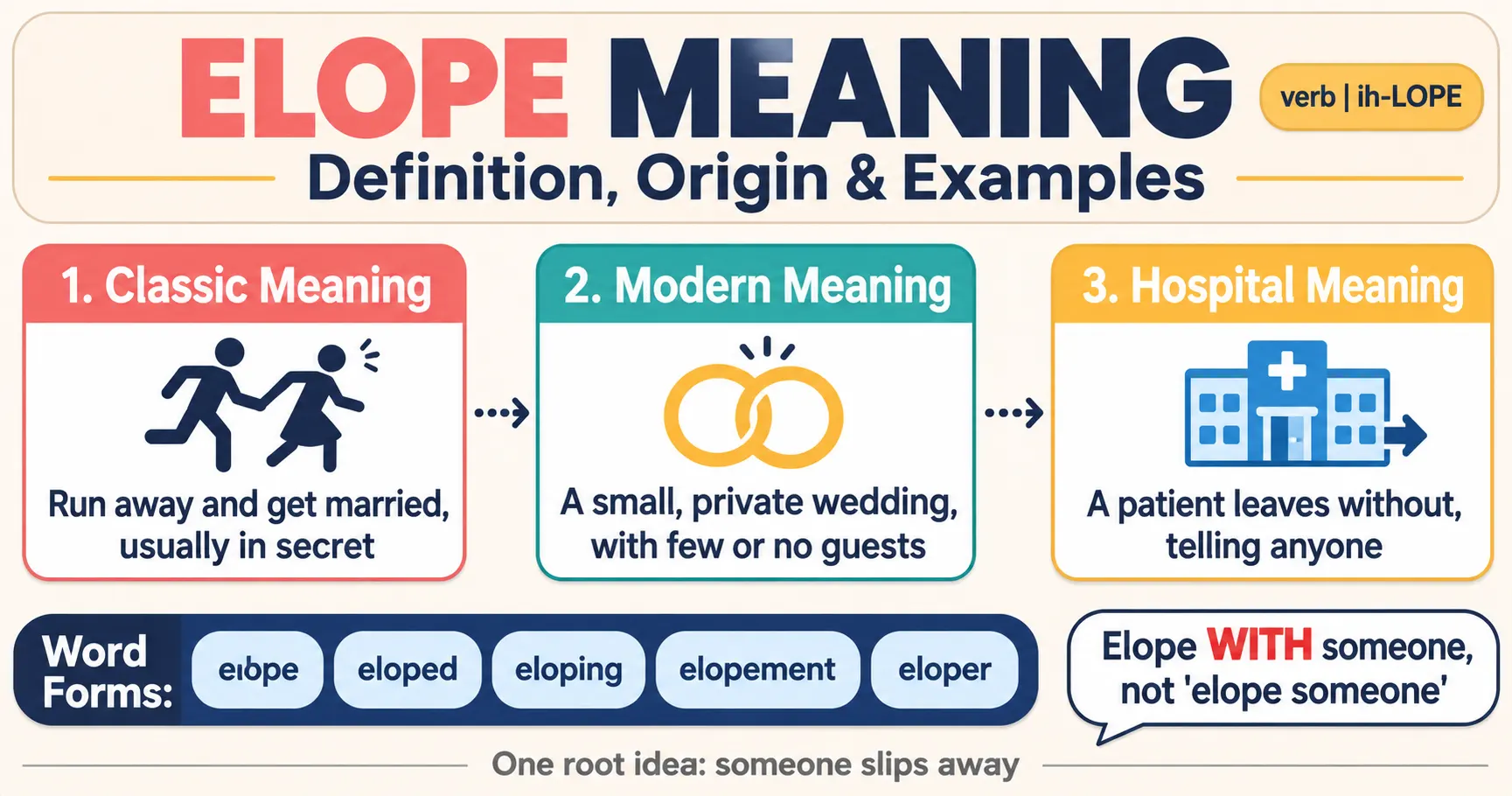
To elope means to run away and get married, usually in secret and without family approval. Today, the elope meaning has widened. Many people use it for any small, private wedding with few or no guests. A third sense, used in hospitals and care homes, means leaving without telling anyone.
You may hear “elope” in a wedding chat, a news story, or a hospital note. Each one uses the word a little differently. As a result, the elope meaning trips up so many people.
This guide sorts it out. First, you will get the dictionary definition, the origin, the old and new meanings, real example sentences, and the mistakes to avoid.
Elope Meaning at a Glance
| Meaning | What It Means | Where It Is Used | Example |
|---|---|---|---|
| Classic | Run away and get married, usually in secret and without family approval | History, novels, news stories | “Her parents said no, so she and Tom decided to elope at midnight.” |
| Modern | A small, private wedding with few or no guests | Wedding planning, everyday talk | “We’re going to elope in the mountains with just a photographer and two witnesses.” |
| Hospital / Care Home | A patient or resident leaves without telling anyone | Hospitals, care homes, medical notes | “The nurse noted the patient was at risk of elopement.” |
What Does Elope Mean?
Elope is a verb. You say it like ih-LOPE. The classic dictionary definition is “to run away secretly to get married.” Also, most dictionaries add that the couple often skips permission from parents or family.
Here are the forms you will see:
- Elope is the base verb. Example: “They plan to elope.”
- Eloped is the past tense. Example: “They eloped last June.”
- Eloping is the ongoing form. Example: “She is eloping with her partner.”
- Elopement is the noun. Example: “Their elopement shocked everyone.”
- Eloper is the person who elopes.
Two quick grammar notes help. First, you can’t elope another person. You elope with them. Say “She eloped with her high school sweetheart,” not “She eloped her boyfriend.” Second, when you name a place, use “to”: “They eloped to Las Vegas.”
Where Does the Word Elope Come From?
The history of this word is tangled. Dictionaries agree on the core idea. The word is about running away. However, they do not agree on every step of the journey.
Merriam-Webster traces it to the Anglo-French word aloper, which meant to abduct or run away. Wiktionary says the Anglo-Norman form came from an older Germanic root for “run away,” and it links elope to the English words leap and lope. Dictionary.com says it probably began with the Middle Dutch word lopen, which means “to run.”
Merriam-Webster lists 1593 as the first known use in English. Also, the noun elopement shows up around the 1540s. Back then, it meant any private or unauthorized escape, especially a woman leaving with a lover.
So the root idea is simple: run away. The marriage part came later.
How Has the Elope Meaning Changed Over Time?
The elope meaning has moved through four stages. Each one added a new layer without erasing the last.
- Escape. At first, the word just meant to flee or run away. No wedding was involved.
- A wife leaving with a lover. In older English, the word often described a married woman who ran off with her lover. In fact, it was close to a legal term for adultery.
- A secret marriage. Later, it came to mean a couple who ran off to marry without permission, often because parents said no.
- A small, private wedding. Today, many people use it for an intimate wedding by choice, not by need.
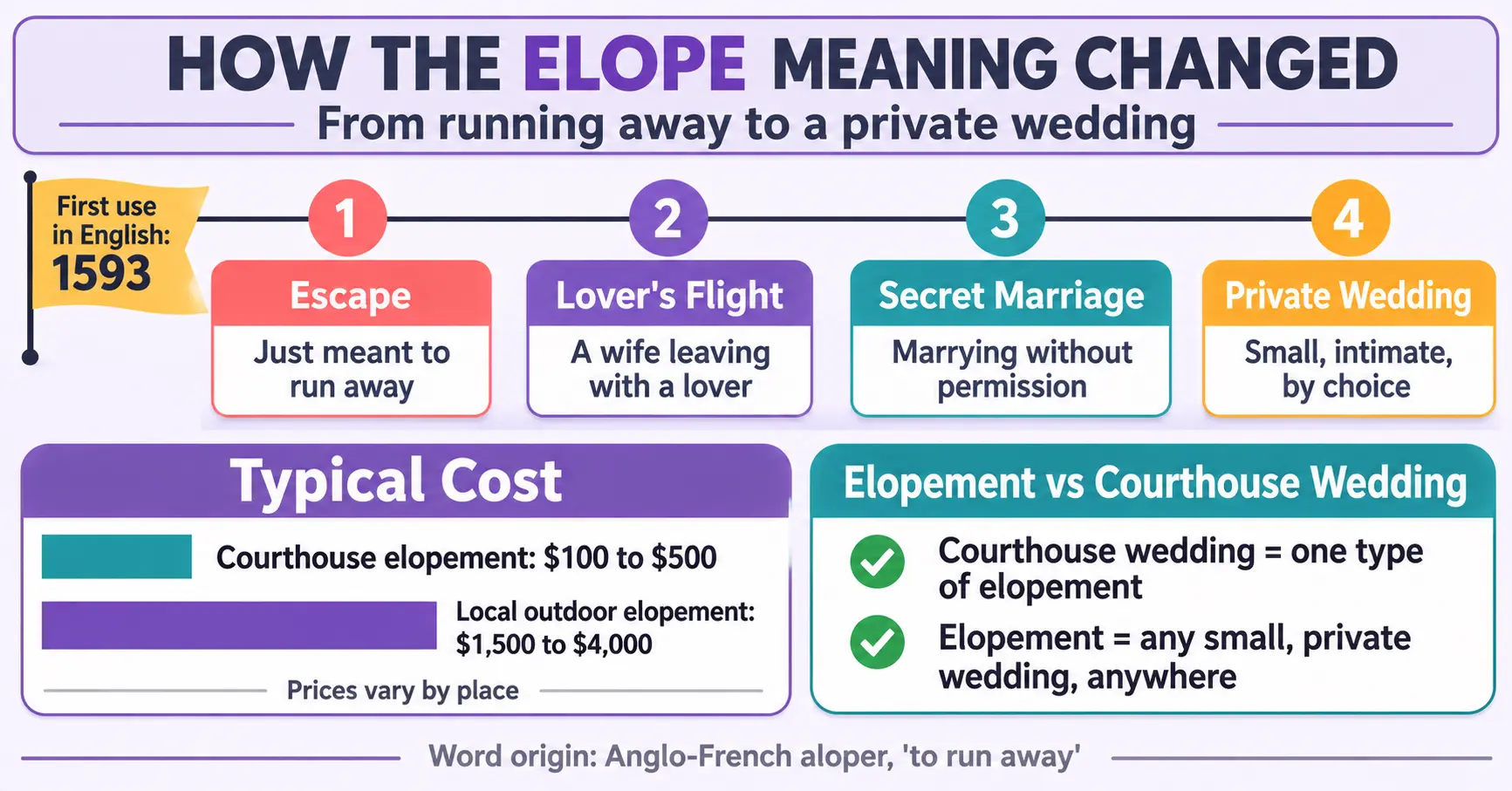
Elope began as “run away” and now often means a small, private wedding that costs far less than a big one.
Hard times pushed the word along. During the Great Depression, eloping grew popular because most couples had little money for a big wedding.
Merriam-Webster has noted that people now use “elope” as shorthand for a small destination wedding, or a wedding that costs far less than the usual kind. However, the same article points out that the old escape sense never died. For example, it lives on in places like psychiatric hospitals.
Words drift like this all the time. For example, take fascist. It began as the name of one specific political movement, but today people stretch it to cover many things. Our guide to fascist meaning shows how a word’s everyday use can wander far from its roots. Still, elope is a milder case of the same thing.
What Does Eloping Look Like Today?
Most people now use the elope meaning to describe a small ceremony. The guest list is tiny. For example, some couples invite no one. Others bring a photographer and two witnesses. Still others bring a handful of close family and friends.
The exact number changes by source. For instance, one common rule says no more than four guests, while planners often stretch it to about ten. Still, what matters is the feel: the day is built around the couple, not around guest expectations.
Secrecy is no longer part of the deal. Many couples tell family before the day, and some invite a few people. Others share the news and throw a party afterward. Also, a modern elopement can happen on a mountain, on a city rooftop, in a national park, or at a courthouse.
The old sense still lives too. In fact, plenty of people use “elope” the classic way, to mean a secret, no-permission wedding. Neither use is wrong, so context tells you which one is meant.
What Does Elope Mean in a Hospital or Care Home?
This one has nothing to do with romance. In care settings, a person “elopes” when they leave a hospital, care facility, or safe area on their own without telling anyone. Staff call this elopement.
The word matters here because the person could be at risk. A patient with memory loss, for example, might walk out and get lost. If you see “elopement risk” on a hospital form, it means the person might leave unnoticed. It does not mean they plan to marry.
This is the oldest sense of the word, the plain “run away,” still doing its job.
Elopement vs. Courthouse Wedding vs. Destination Wedding
People mix these terms up all the time. They overlap, but they are not the same thing.
| Feature | Elopement | Courthouse Wedding | Destination Wedding |
|---|---|---|---|
| What it is | Any small, private wedding, anywhere | A quick legal ceremony at a government building | A wedding held in another place, even another country |
| Guests | None, or a handful (about 4 to 10) | Usually just the couple and witnesses | Varies |
| Where | Mountain, rooftop, park, courthouse, abroad | Courthouse only | Another city or country |
| Speed | Depends on the plan | Within days | A few months |
| Typical cost | Local outdoor elopement: $1,500 to $4,000 | About $100 to $500 | Varies a lot |
| Relationship | The wider term | One type of elopement | Can also be an elopement if it is small and private |
A courthouse wedding is one kind of elopement. It is a quick legal ceremony at a government building. But not every elopement happens at a courthouse. Instead, an elopement can happen anywhere, including another country.
Many couples mix the two. They do the paperwork at the courthouse, then head out for a private dinner or a hike.
Cost is a big reason people look at elopements. One planner estimates a courthouse elopement at roughly $100 to $500. A local outdoor elopement with an officiant, photographer, and outfits runs about $1,500 to $4,000, by the same estimate. Also, prices vary a lot by place and by what you include.
Why Do Couples Elope?
People choose to elope for many reasons. Here are the most common ones:
- Money. A small day costs a fraction of a big wedding. Some couples put the savings toward a trip or a home.
- Less stress. No seating charts, no vendor calls, no family politics.
- Privacy. Some people just do not want an audience.
- Adventure. A beach, a mountain, or a faraway city can make the day feel special.
- Speed. A courthouse elopement can happen within days, while a destination one needs a few months.
- Meaning. The day feels more personal when every choice is the couple’s own.
A warning from one planner is worth repeating. If you elope mainly to dodge a hard family talk, the talk will still happen later. So telling close family early, or sharing the news with photos and a party, softens things.
Guests sometimes feel a pinch of FOMO when they hear about an elopement after the fact. FOMO means “fear of missing out,” and our guide to FOMO meaning explains the full story. Couples can ease that feeling by sharing pictures or planning a casual celebration later.
Some couples also care about the date itself. A few pick days like 11/11 or 4/4 because the numbers feel meaningful to them. If you have ever wondered why people read signs into repeating numbers, our pages on 1111 angel number meaning and 444 meaning break down what believers say about them.
How Do You Use Elope in a Sentence?
Seeing the word in action makes the elope meaning click. Here are examples for each sense:
- Classic sense: “Her parents said no, so she and Tom decided to elope at midnight.”
- Modern sense: “We’re going to elope in the mountains with just a photographer and two witnesses.”
- Noun: “Their elopement surprised everyone, even their closest friends.”
- News style: “The couple eloped in Las Vegas and told their families the next day.”
- Care setting: “The nurse noted the patient was at risk of elopement and checked the exit daily.”
- Texting: “Wait, they eloped?? smh, I wasn’t even invited.”
Finally, that last one shows how the word shows up in everyday chat. Here, “smh” means “shaking my head,” so it signals mild disbelief or annoyance. Our SMH meaning page covers how to use it.
What Are Some Synonyms for Elope?
The best synonym depends on which meaning you want.
For the classic sense, try these:
- Run off
- Run away together
- Slip away
- Steal away
- Abscond (more formal)
For the modern sense, these come close:
- Hold a private ceremony
- Plan an intimate wedding
- Throw a micro wedding
- Get married quietly
For the care sense, “wander off,” “leave without notice,” and “go missing” fit best.
Watch out for look-alikes. Interlope means to intrude on someone else’s business, while elapse means that time passes. Either way, neither has anything to do with weddings.
Common Mistakes With the Elope Meaning
A few errors come up again and again:
- Thinking elope always means secret. Yet many modern elopements are planned and shared with family.
- Thinking eloping is illegal. A small wedding is as valid as a big one when you follow local rules.
- Saying “elope someone.” The verb does not take an object. Use “elope with.”
- Assuming a courthouse is required. A courthouse is only one option.
- Using it for any runaway. Outside care settings, “elope” almost always involves marriage. For example, a teen who leaves home did not “elope” unless a wedding is part of the story.
- Mixing up the word with similar ones. Interlope and elapse sound close but mean something else.
Is Eloping Legal?
In general, yes. A couple who follows local rules for a license, witnesses, and an officiant is legally married. A quiet wedding counts the same as a big one.
However, rules differ by place, especially in other countries. For example, some places need paperwork weeks ahead, while others have residency rules. So check with the local marriage office before you book anything. This is general information, not legal advice, so ask a local official or lawyer about your exact case.
Elope Meaning FAQ
What is the simple elope meaning?
To elope means to run away and get married, often in secret. Today it also describes a small, private wedding with few or no guests. Also, in hospitals, it means a patient leaves without telling staff.
Does elope mean you have to marry in secret?
No. That was the old meaning. Now, many couples tell family ahead of time or invite a small group, so the modern elope meaning focuses on keeping the day intimate, not hidden.
Is eloping the same as a courthouse wedding?
Not exactly. A courthouse wedding is one type of elopement. Eloping, though, is a wider term that covers any small, private wedding, whether at a courthouse, on a mountain, or abroad.
What does elopement mean in a hospital?
It means a patient or resident leaves a hospital or care facility without telling anyone. That has nothing to do with marriage, and staff track “elopement risk” to keep people safe.
Where does the word elope come from?
It comes from older words meaning “to run away,” through Anglo-French and Anglo-Norman, with links to Middle Dutch. Also, the first known use in English dates to 1593.
Final Thoughts: Elope Meaning in Short
The elope meaning depends on who is talking. A history buff means a secret, unapproved wedding, while a wedding planner means a small, private ceremony. Meanwhile, a nurse means a patient who left without notice. Still, all three share one root idea: someone slips away.
When you meet the word, check the setting. Look at who is speaking and what they are describing, because that tells you which meaning applies. Also, if you plan to elope yourself, check your local marriage rules first, pick a size that feels right, and tell the people you care about in a way that suits you.
For a deeper understanding of the word, explore the Merriam-Webster explanation of how the meaning of “elope” has changed and its historical roots through Etymonline’s word origin guide. These resources offer more insight into how elope evolved from meaning “to run away” to describing a private wedding. Understanding its history makes the modern elope meaning even clearer.