

The FOMO meaning is simple enough: “fear of missing out” is the uneasy feeling that is created when others are having fun, and you are not. You know that a friend has been promoted for a job, a “last chance” sale, you missed a party or you have a little knot in your stomach.
The FOMO meaning is discovered by the majority of people when they encounter the word in a chat, reel, or news article. This may be a simple statement, but it could affect the way that folks spend, their temper, and what they eat.
FOMO is the fear of missing out, if you don’t know what it is! How is it that you don’t feel like part of all this? But why is it that brands continue to utter “only 2 left”? Or, simply a way to unwind from everything you’re not doing? This guide helps you to understand the word’s meaning, how you will use it, and how it is used in practice.
What is the FOMO meaning, and what is the meaning of the FOMO full form?
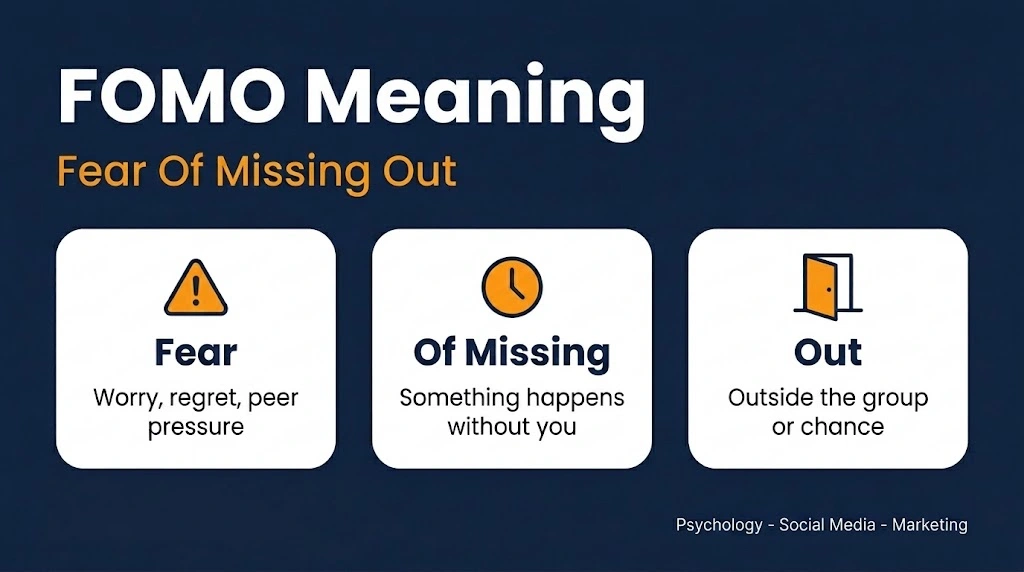
FOMO = Fear Of Missing Out. The acronym FOMO stands for ‘Fear of Missing Out’ and it’s the worry that you might feel when you’re not at an event, activity, listening to something or seeing something that you think you should be at.
Let’s look at the following FOMO meaning, word by word.
- Fear is a mixture of Concern, Remorse and Peer Pressure.
- Of absence: What ifs and wishes as if something is going on without you.
- Excluded: Feel not included in a group, conversation or opportunity.
F.O.M.O is often adopted in Hindi as meaning, “kuch chhut jaane ka dar” (fear of missing something).
This concept has been in existence for some time. The term ‘fomo’ first came to be used in a 1996 article by marketing research professor Dan Herman and was coined in the Harvard Business School magazine, The Harbus, in 2004. It was added by the Oxford English Dictionary in 2013.
Why Do I Feel FOMO? Why it happens.
The FOMO psychology starts from the simplest desire of humans: We want to belong. When we feel others are having an experience without us, the mind perceives as a small social threat. How a feeling can be so strong even if the event that you didn’t attend is not important to you.
It’s usually due to one of the following:
- Fear of regret. If you decide to take one option, you may think that you will have to deal with the second, lesser evil.
- Social comparison. You make comparisons between your life and what others tell about their life.
- Mistake: Wish to make contact. You need to know – at all times!
If you didn’t do it on Saturday then you’ll have a day to recuperate. Then you get up and check out pictures of other people’s parties on your cell phone. Then you switch on your cell phone and view photos of a friend’s party. You don’t know what you have been up to all day but you feel like you’ve made a mistake. The FOMO real-life meaning is much more than “I wanted rest”, it’s “I am missing out”.
However, is it “normal” to have FOMO or is it an issue?
FOMO is a very normal, human emotion and one that might be a healthy one. According to one source in psychology it is referred to as a form of social anxiety, but not a social anxiety disorder. This is a “diagnosis” by this writer only; not an official diagnosis.
There have been links made between high FOMO levels and anxiety, mood disorders, and poor quality of life. They are not solely based on FOMO, these are correlations. It’s important to take note when it leads you to keep scrolling late into the night, when it leads you to say yes to anything, or when it makes you feel bad most of the day.
So what’s particularly bad about FOMO on social media?
One main reason FOMO is more potent on social media than it is in real life is that you can see all the others doing, all day long. Mostly highlights are displayed such as trips, parties and wins are shown. They don’t display the line features or mundane areas on them.
It’s exacerbated by three things that go wrong:
- Checking constantly. Looking and thinking more will lead the way to more excuses not to be included.
- Comparing highlight reels. You’ll learn the difference between your ordinary day and another persons best moment!
- Late-night scrolling. If you are tired, then your eye will be more receptive to what you’re seeing.
The scientific studies have revealed that FOMO can be linked to problematic use of social media and how it can be a vicious circle: feel excluded, check more, feel more excluded!
What is the FOMO and How it can be utilized in marketing and investing world?
There is a planned FOMO in marketing. Brands realize if somebody doesn’t receive something, they would be quicker to take action. This is how you end up with “limited stock,” “offer ends tonight” and “1,200 people are viewing this.”
All uses are not manipulative. In case you have the ability to see the real customers use it, you can make a choice. The issue is, the pressure is being applied, say for example there’s a fake countdown timer, which resets when the page is refreshed.
Test before this impulse buy: Is this something you’d like today? If the answer is ‘no’, the answer is probably more to do with the work itself, than the product.
The same applies in investments, when the pressure is applied to make an investment that “everybody else is making” they invest with this attitude. This does not constitute financial advice, it’s information. If in any doubt do research, then proceed.
FOMO Vs JOMO vs FOBO?
The three terms are all easily confused. The two types of them are different in the following aspects:
| Term | Full form | What it means |
|---|---|---|
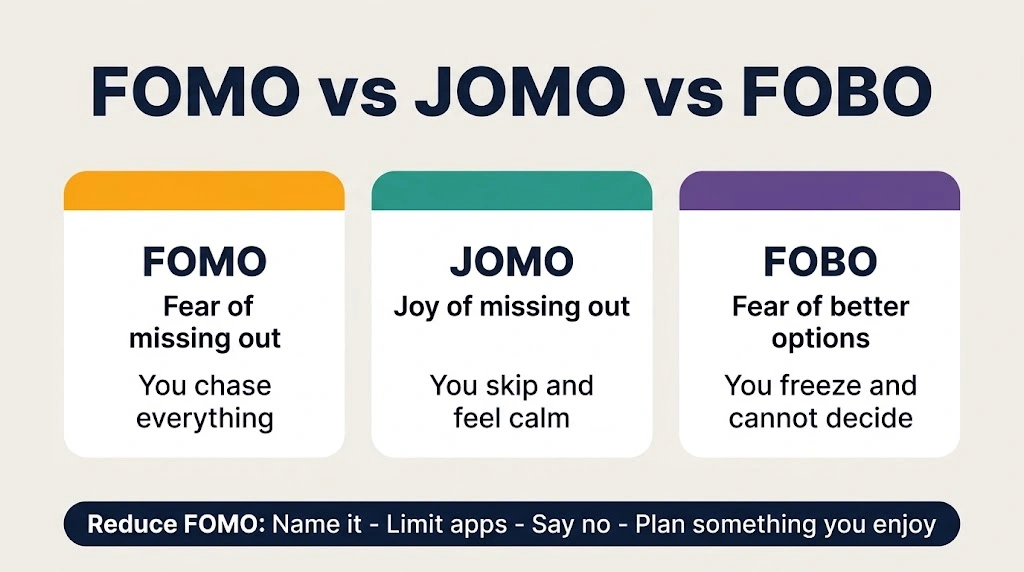
| FOMO | Fear of missing out | Don’t feel happy about something you desire. |
| JOMO | Joy of missing out | The cheerful and satisfaction about leaving out activities |
| FOBO | Not being confident in other options | I’m not certain which one to choose as I want to hope that it is not the very best. |
In other words, FOMO is about pursuing, FOBO is about freezing and JOMO is about enjoying it in a calm manner.
Here are some steps to help lower FOMO:
Unfortunately, FOMO is a must these days, but it can be somewhat smaller. Do each of these steps in turn:
- Name the feeling. Remember “FOMO”. Once it has been named, it isn’t as powerful.
- Speak in a very clear manner, say what you mean. Would you be satisfied if you were invited or not?
- Limit Apps. Try using a daily timer and try to have your cell phone away for the first 30 minutes and last 30 minutes of the day.
- Cease doing whatever leads you to feeling depressed. Close accounts if users don’t feel good after scrolling. Don’t sign up to account that makes you feel bad after you scroll through.
- Make a plan for an activity that you enjoy. You do have your own ‘highlights’ walks, your friend calls, your hobby etc.
- Purposefully say “no. The more you intentionally miss it out on, the more habit you’ve formed of JOMO.
- Every day – List 3 things that you are grateful for. To focus on positive rather than negative things.
Determine when to seek the advice of a professional.
If you are feeling anxiety or depressed most of the time or if FOMO is affecting your sleep, work or relationships, seek advice from your doctor or counselor. You can ask for assistance in doing this.
FAQ about fofo meaning
How to say FOMO?
Most often called by its vernacular “FOH-moh” with both syllables spoken as “foe” and the word “mo”.
Is there a time, place and situation in which FOMO is a good thing?
Sometimes. Just a little of FOMO can motivate you to contact a friend, do something different or take a chance. It’s not very helpful if it leads you to do things because of fear and not because of choice.
When is the feeling of “FOMO” when making an investment decision?
Pay attention for signs of being rushed, emulation (doing something without knowing what it is) or “missing the boat. Discern those—get away from them, find out what the facts are. This is a general information and not financial information.
Conclusion
FOMO is fear of missing out, but the definition of FOMO is much more than an acronym, it is the fear of missing out on life. It’s based on the sense of belonging, is filled with social media and is sold with urgency.
The positive side to it is that you are not destined to do so forever. Identify the emotion, look at what you ACTUALLY want, limit scroll and ‘zone out’. Understanding the meaning of FOMO and how it got here can assist you to think about what you need to say “yes” to as opposed to “no”.
Want to read more? Mental Health @ Home’s explainer on what FOMO is and how it affects behaviour covers the origin of the term and the research behind it in plain language.
[…] is full of short reactions that carry a lot of feeling. If you like decoding them, our guide to FOMO meaning covers another term you will see all the […]
[…] FOMO: “fear of missing out.” In fact, you often feel it when someone else gets put on to something first. Read more in our guide to FOMO meaning. […]
[…] like FUPA are built the same way as FOMO, which stands for “fear of missing out.” Both took a long phrase and shrank it into a word […]
[…] great. It is short, symmetrical and available in any language. Similarly, with modern slang such as FOMO or SMH, everyone understood at once, and SOS is no exception. This is also the SOS meaning; for […]