
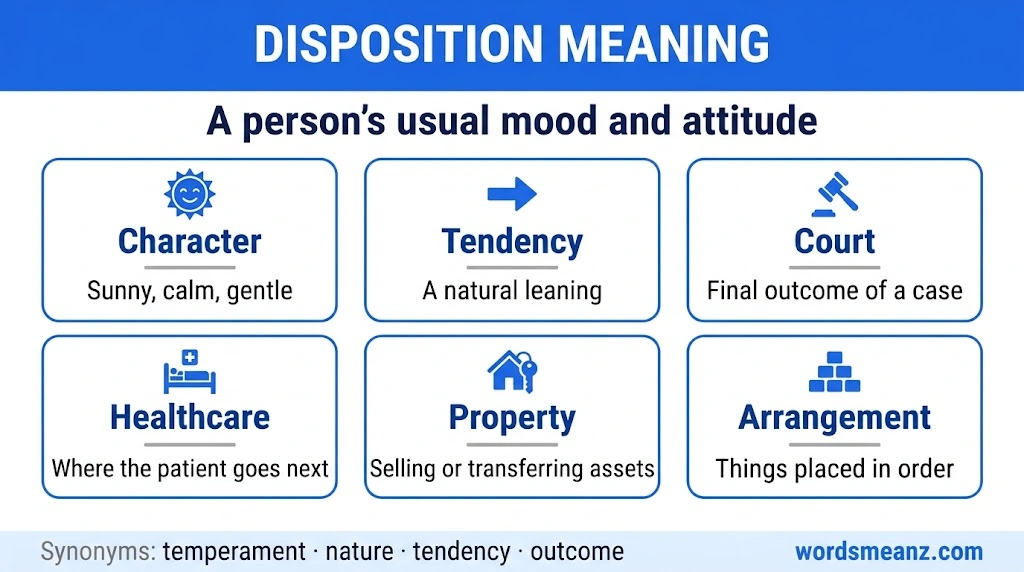
The disposition meaning is someone’s temper and disposition, the way he or she typically is. For example, someone is likely to be happy if they have a cheerful disposition. In the law, disposition is the final resolution of a case. It can also refer to an inclination, or to the disposition of an object.
You will hear this word at work, in court and at the doctor’s office. But it does not refer to the same thing in every location. So this guide reviews all the meanings, each in simple English, with examples that you can copy.
What Does Disposition Mean?
Disposition is a noun. You say it dis-puH-ZISH-un. The plural of disposition is Dispositions.
Most people use it mainly for character. For example, “She has a kind disposition” means that she is generally kind. This is the basic disposition definition.
The word, however, has other roles. It can refer to a tendency towards a particular thing. Courts also use it to explain the conclusion of a proceeding. Doctors describe a patient’s destination following treatment with it. And it can explain the organization of things.
Here you go, a quick look at it.
| Meaning | Plain definition | Example |
|---|---|---|
| Character | A person’s usual mood and attitude | She has a warm, easy disposition. |
| Tendency | A natural leaning to act a certain way | He has a disposition to trust people fast. |
| Court | The final outcome of a case | The disposition was “dismissed.” |
| Healthcare | Where a patient goes after treatment | The disposition was discharge home. |
| Property | Selling or transferring assets | The disposition of the assets took a year. |
| Arrangement | The way things are placed in order | The disposition of the troops changed overnight. |
Context determines what is meant. If the sentence is about a person, then it is about character. But if the sentence refers to a judge, it is a case sentence.
Disposition Meaning for a Person’s Character
This is the common use. Your disposition is your natural state of mind and your innate attitude. In other words, it is the attitude you must display.
Remember someone who remains at the center when things go wrong. One might say that she is of a placid temperament. In contrast, consider someone at your place of work who is short-tempered. One could say he’s a hostile type of person.
There are words that appear repeatedly with disposition:
- Positive: sunny, cheerful, sweet, gentle, friendly, easy going, even
- Positive: cheerful, good-natured, pleasant, cheerful, tense, irritated
Here are a few examples:
- New teacher is optimistic.
- “He is a gentle dog, and good with children.”
- He had been “stressed out for years and got a sour attitude.”
Be aware that disposition has to do with the pattern (not one moment). So don’t let a bad morning affect your temper. However, a tendency to morning lousiness may.
People also use the word to refer to animals in shelters and vets. For instance, a dog that is good in every way is easy to handle, friendly and calm.
Disposition Meaning as a Tendency
Another definition of disposition is a way of leaning naturally. It’s a tendency to do something or think a certain way. People often use it in combination with “to” or “toward.”
- “He is easily fooled.”
- “She didn’t seem to be like the sort of person who gives up.”
- There are some people who have an inherited tendency to develop certain illnesses.”
This use is formal-sounding. Instead, most people would typically say “tendency” or “habit” in casual conversation.
One more point. Disposition relates to one’s temperament. It doesn’t call out a belief system. So, fascist is not a mood nor a temperament, it is a political ideology and a form of government. We have a fascist meaning guide for that meaning. However, it is not a political term to say a writer has a controlling disposition, it’s a word that describes a personality trait.
Disposition Meaning in Law and Court
The word disposition seems to have a different meaning in court. It is the result or decision of a case or issue. In short, this is the ending of the case.
Common dispositions include:
- Conviction
- Acquittal
- Dismissal
- Plea deal
- Settlement
A disposition is not the same as a verdict. A verdict is the result of a trial, whether the court declares the defendant guilty or not guilty. The overall effect is disposition. In fact, there will never be any verdict, and a judge may dismiss a case.
Another term for this is “disposition hearing.” This hearing is the one in which the judge determines what will occur next in many juvenile courts. It operates in a similar fashion to sentencing in an adult court.
The laws vary from country to country and state to state. So if it’s a genuine instance, consult a lawyer. The information in this article is for general information only.
What Does Disposition Mean on a Background Check?
It’s one of the top search uses. The disposition is part of a background check that indicates the outcome of a charge.
These words may appear on you:
- Innocent: the person was not guilty, and the court did not find the person guilty.
- Dropped by court: the court withdrew the charge.
- Acquitted: the court found the person NOT guilty.
- Pending: The case is still pending, and the court has not yet resolved it.
- Suspended: The sentence remains in effect, but the court postpones it, usually while in probation.
However, don’t assume the worst if there is no disposition in a record. It may signify that the case is pending. It also could indicate that the record is not complete. So those seeking clarification can request a copy of the entire record from the court clerk.
Disposition Meaning in Hospitals and Healthcare
This is the disposition in a hospital or emergency room. At the end of a visit, staff writes it down.
Typical examples:
- Discharged home
- Admitted to the hospital
- Moved to another center; or: Sent elsewhere.
- Failing to adhere to a physician’s orders.
For example, a nurse may ask, “what is the condition on bed 12?” She asks herself, what is that patient doing, is he/her going home, going up the stairs or going somewhere else? However, the specific terms will differ depending on each hospital and billing system.
Disposition of Property, Assets, and Remains
In business or estate law, to dispose of is to sell, give away, or transfer. For instance, a company may plan to dispose of an old factory. That is to sell it or give it away.
The concept behind wills is the same. It is a declaration of what to do with a person’s estate after their death. As a result, the term “disposition of property” appears frequently in these documents.
Finally, there’s one other use. Final disposition may describe the fate of a body after it dies, e.g., burial or cremation.
Disposition Meaning in Psychology and Science
Psychologists use the word with greater care. A dispositional is a permanent characteristic of a person. Optimism is a case in point. Researchers say that people who have a positive outlook on things in many situations have dispositional optimism.
Also, there is a well-known concept termed dispositional attribution. To attribute to a person’s disposition rather than to their circumstances. For example, if a driver cuts you off and you say to yourself “what a jerk,” you made a dispositional call. In contrast, if you think “maybe he is rushing to the hospital”, you made a situational one.
Philosophers employ the word too as well. For example, a glass has a tendency to break upon impact. You can safely place the glass on a shelf for years, but the property remains the same. It doesn’t appear unless the circumstances are right.
Disposition Meaning as an Arrangement
This feeling is more primitive and less prevalent in the current society. It is a manner in which people arrange or organize things.
- The layout of furniture in the room created a spacious environment.
- “Generals learned of the enemy’s disposition.”
In fact, armies still use the term “disposition of forces” to indicate the position of forces. Writers on architecture and design also occasionally employ it.
Where Does the Word Disposition Come From?
Disposition came into English in the 14th century. It comes from the Latin word dispositio. The root of this word is disponere, meaning “to arrange.”
This is why there is an unusual range of meanings. At first, the word meant to “order things”. As time went on, they employed it to refer to the interior of a person: one’s personality or state of mind. After that, courts used it for the verdict at the conclusion of a case.
How to Use Disposition in a Sentence
Real examples assist most. We list them by use.
| Where you’ll see it | Example sentence | Meaning here |
|---|---|---|
| Everyday talk | Our new neighbor has a friendly disposition. | Usual mood |
| Pets | The shelter says the puppy has a gentle disposition. | Animal temperament |
| Court | The disposition of the case is still pending. | Final outcome |
| Hospital | His disposition after the visit was admitted. | Where the patient goes |
| Business | The firm approved the disposition of two old offices. | Sale or transfer |
| Psychology | She has a disposition toward optimism. | Stable tendency |
Friends, here are a couple of guidelines for natural use:
- Use it in combination with an adjective: “a warm disposition,” “a nervous disposition.”
- For results use ‘of’ instead of ‘disposition of case’.
- To or towards for tendencies: “a tendency to worry”.
Synonyms and Antonyms of Disposition
The best synonym depends on the meaning.
Character: temperament, nature, personality, makeup, spirit, outlook, demeanor
Leaning: inclination, a likelihood to do something, a predisposition or proclivity toward something.
Arrangement: a layout, or things placed in some order or position.
Favourable result in a court of law: a settlement or conclusion, an outcome, or a ruling. Synonyms: resolution, settlement, outcome, ruling
There is no perfect opposite. However, you might use aversion or resistance for tendency. Likewise, you can use disorder or disarray for arrangement.
Disposition vs. Temperament vs. Personality vs. Mood
These words overlap, and people confuse them. Here’s the difference.
| Word | What it focuses on | Example |
|---|---|---|
| Disposition | Usual mood and attitude | Her calm disposition helps in a crisis. |
| Temperament | Inborn emotional style | The baby has an easy temperament. |
| Personality | The whole pattern of traits | His personality is loud and funny. |
| Mood | A short-term feeling | I’m in a bad mood today. |
| Character | Moral qualities and values | She showed strong character. |
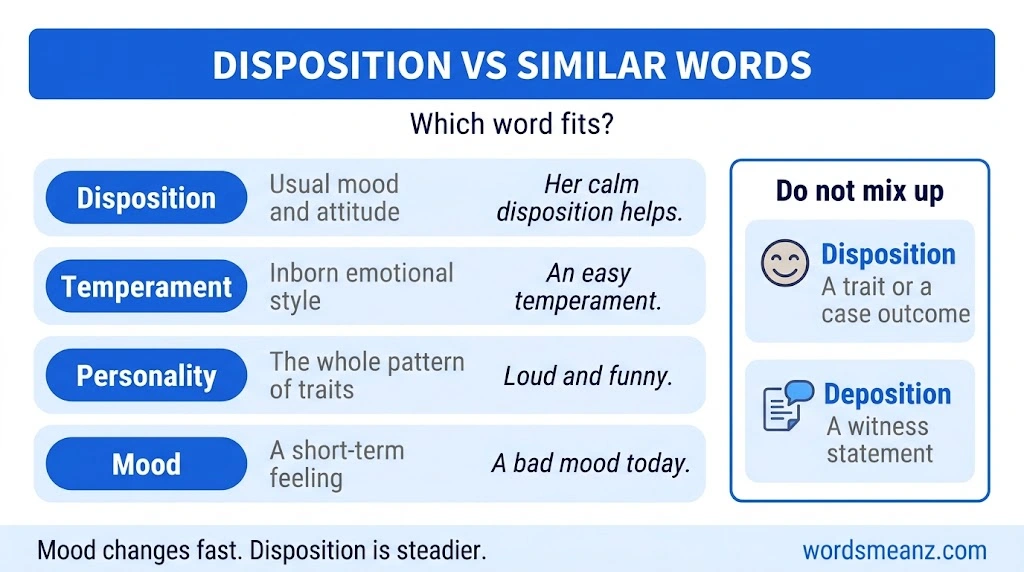
Mood changes fast. Disposition, however, is steadier. Personality is the whole story, and disposition is one part of that story.
Disposition vs. Deposition, Predisposition, and Disposal
Some words have a similar spelling but a different pronunciation, leading to errors.
Deposition
A statement taken from a witness not in court. It can also imply the ousting of a person from power. It has nothing to do with mood. For example, the term “she gave a deposition” is a legal term. In contrast, a cheerful disposition is a characteristic of her.
Predisposition
A leaning that occurs well before anyone can see it. Doctors use it for health risks. People commonly use the term “allergic tendency.” So if you speak about the typical nature of someone’s temperament, use the word disposition, not predisposition.
Disposal
To dispose of means to get rid of something. The classic case is the “waste disposal. Disposition can share this meaning in business, as in “disposition of assets”, but disposal is the better word for trash.
Can a Person’s Disposition Change?
Yes, but slowly. It’s a combination of habits, health, sleep, stress and relationships. For example, someone who cultivates gratitude and who receives support feels lighter over time.
Others seek sign and patterns to get a feeling of stability. Number Patterns are a popular topic. If you’re in for it, check out our 444 meaning and 1111 angel number meaning articles. So, regardless of what you may think about them, it’s the same thing that’s helpful. By consistently focusing on positive aspects, you can foster a positive mindset.
Disposition in Texting and Online Talk
Very few people use the word disposition in a group text. However, it is evident in people from how they respond.
For instance, if someone responds to all posts with SMH, they might have an incuriosity or disillusionment attitude. Likewise, someone who can’t seem to refrain from scrolling due to FOMO exhibits anxiousness. Both reactions are not an accurate reflection of a person’s entire character. Still, repeated habits of this kind exactly point to what “disposition” refers to.
Common Mistakes With Disposition
- Its use as a short mood. This statement sets the tone: “I’m in a bad disposition today.” Tell him or her that you are in a bad mood.
- Used with deposition: “To mix it up with deposition. One is a characteristic or a result. The other one is a witness statement.
- Misspelling ‘disposition’ with the word ‘disposal’. Dispose of garbage and trash.
- A “no disposition” record is excellent news! It might simply be a case of the case being open.
- Skipping the adjective. The meaning of “disposition” is ambiguous for “She has a disposition. Tell what type of kite: sunny, calm, nervous.
Disposition Meaning FAQs
What is the simple meaning of disposition?
A person’s usual state of mind and disposition. It’s a person’s general manner of feeling and acting.
What does “cheerful disposition” mean?
It indicates that the person is typically cheerful and optimistic.
What does disposition mean in court?
The result of a trial, for example a finding of guilty or not guilty, or dismissal.
What does disposition mean on a background check?
Indicates a charge that was complete. Typical results are conviction, dismissal, acquittal or pending.
Is disposition the same as personality?
Not quite. The disposition is a part of the personality. It includes your normal mood and attitude, while personality includes all of your traits.
What is the difference between disposition and deposition?
Disposition: A characteristic or an outcome of a case. Deposition is a statement requested of a witness not given in court.
Final Word on the Meaning of Disposition
Disposition: a natural bent, a final outcome, a disposition, a usual mood. So it is up to the setting to indicate which one applies. For humans, consider a character. To courts, consider results. If you’re in a hospital, consider where you should go next.
Want to check the word in a trusted dictionary? The Merriam-Webster entry for disposition lists each sense with its own example sentences. Likewise, it helps you see how the meaning changes between everyday talk, law, and writing.