
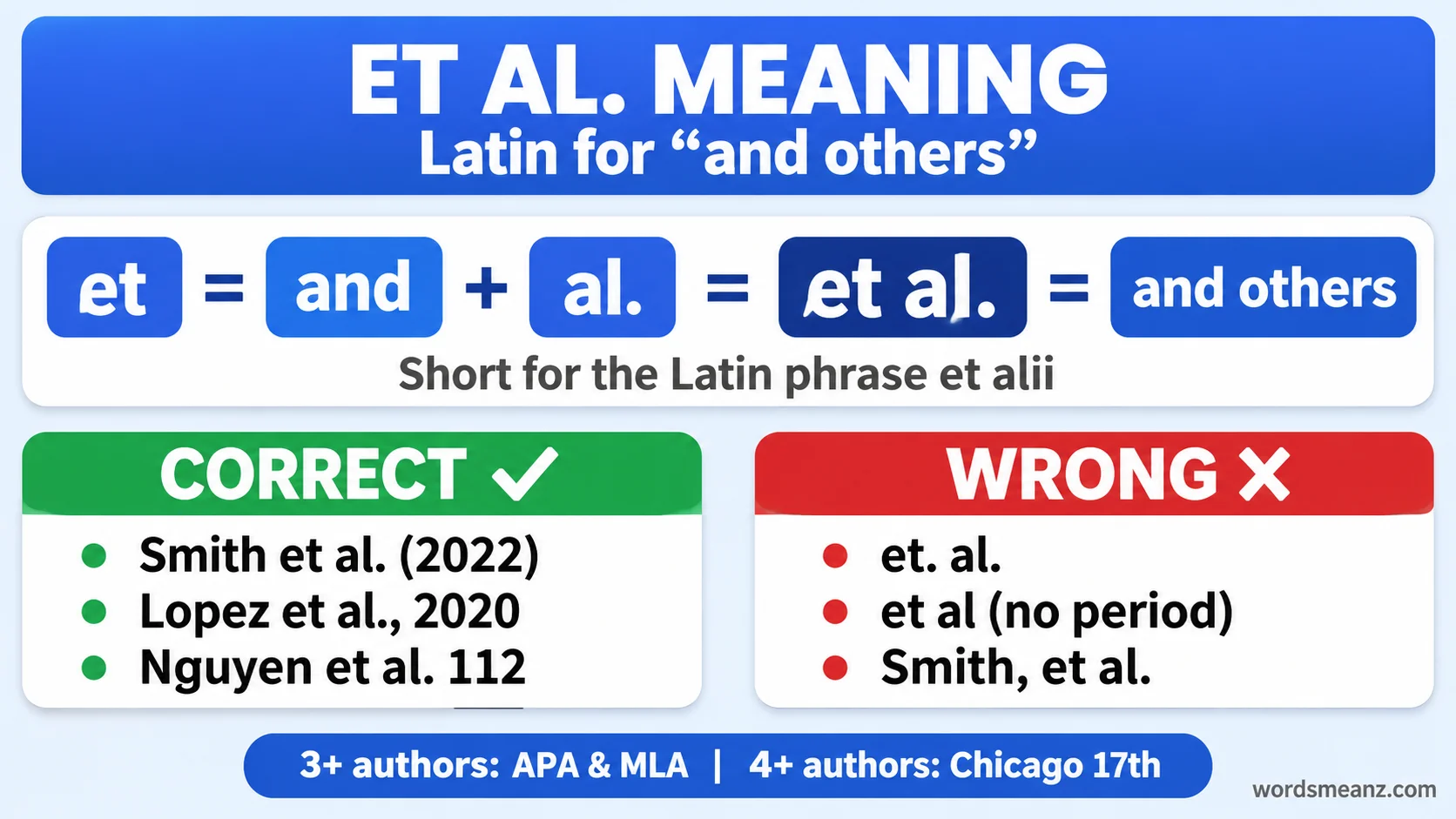
The et al meaning is simple: et al. is a Latin abbreviation for “and others.” Writers use it in citations to name the first author and skip the rest of a long author list. The period goes after “al” only, never after “et.” Example: Smith et al. (2022) found that sleep improves memory.
You have probably seen this little phrase in a school paper, a news story about a study, or the title of a court case. Then you wondered what it was doing there. The et al meaning is simple, and so are the rules for using it. This guide covers what it means, where it comes from, how to say it, and how to write it in APA, MLA, and Chicago style.
If you like cracking short forms, our guide to what SMH means covers a very different kind of shorthand. However, this one is the formal, academic kind.
What Does Et Al. Mean?
Et al. means “and others.” It stands in for names you do not want to list one by one. So you put it right after the first name, and the reader knows more people are behind the work.
In plain terms, “Johnson et al.” means “Johnson and the other authors.” That is all there is to the core et al meaning. Also, the same et al meaning applies in law, science, and school papers.
First, here is the quick breakdown.
| Part | Latin | Meaning |
|---|---|---|
| et | et | and (a full word, no period) |
| al. | alii / aliae / alia | others (shortened, so it takes a period) |
| et al. | et alii | and others |
The phrase is plural. Because of that, it always stands for at least two more people, so it never fits a two-author source. For example, if a paper has exactly two authors, you name both of them.
Why Do Writers Shorten Author Lists?
Space is the first reason. A research paper can have ten, fifty, or even hundreds of authors. Also, listing them all in every sentence would bury the point you are trying to make.
Readability is the second reason. For example, “Garcia et al. (2021) found a link” is quick to read. A line with eight surnames is not.
Credit is the third reason. Et al. still tells the reader that a team did the work and that the first name on the list led it. The full list sits in your reference section for anyone who wants it. So the et al meaning is not only “and others.” Besides that, it is a promise that the missing names are easy to find.
Where Does the Phrase Come From?
Et al. is short for the Latin phrase et alii. Latin has three forms: et alii for a group of men or a mixed group, et aliae for a group of women, and et alia for things. In short, all three mean “and others.”
Today, English writers shorten all of them to the same two letters. Etymonline dates the English abbreviation to 1883. In modern writing, nobody checks the gender of the group. So et al. covers everyone.
English borrowed lots of Latin shorthand this way. A word like fascist also traces back to a Latin root, though it took a very different road into everyday speech. Still, et al. stayed in the world of books, research, and law.
The “al.” part also hides a family of familiar words. Alii is related to “alias” (another name) and “alibi” (another place). Once you see that link, the abbreviation stops feeling random.
How Do You Pronounce Et Al.?
Most people say “et AL” or “et ALL.” Dictionaries also list a few accepted versions, including “et-AWL,” “et-AHL,” and “et-AL.” All of them are fine.
Some speakers, especially in formal talks, say the full Latin ending: “et AL-ee-eye.” However, you will rarely need that. So if you are reading a paper aloud, “Smith et al” said like “Smith et all” will sound normal to nearly every listener.
As a rule, say “and others” aloud only if you want to explain the term. Also, do not swap it in mid-sentence unless the speaker’s style calls for it.
How Do You Write Et Al. Correctly?
Writing et al. has three rules.
- Put the period after “al” only. “Al” is a shortened word, so it needs the dot. But “et” is a full Latin word that means “and,” so it does not.
- Do not put a comma before it. Write “Taylor et al.” and not “Taylor, et al.” in APA, MLA, and Chicago in-text citations. (MLA’s Works Cited entry is the exception: it uses “Smith, Jane, et al.”)
- Skip the italics. Older books italicize it because it is Latin. APA, MLA, and Chicago do not require italics today. IEEE is one style that still does.
When et al. ends a sentence, you use one period, not two. “The study was led by Chen et al.” is correct.
How Many Authors Before You Use Et Al.?
It depends on your citation style. Most styles switch to et al. at three authors. However, Chicago waits until four. Always check the guide your teacher, journal, or editor asked for, because Harvard rules vary by school.
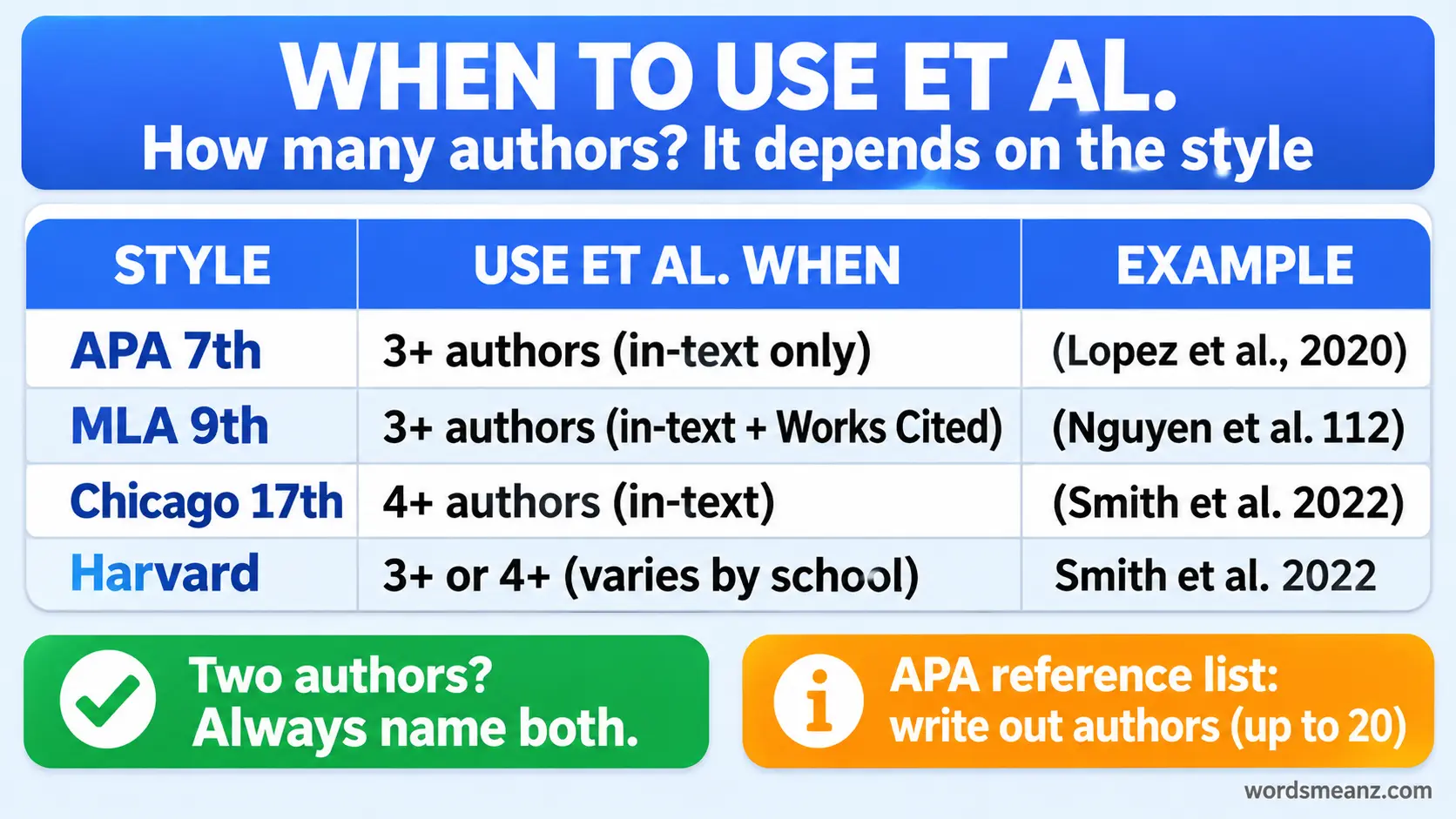
Still, one rule holds across almost every style: two authors always get both names. So never write “Smith et al.” for a two-author paper.
APA Style Rules
In APA 7th edition, you use et al. in the in-text citation when a source has three or more authors. Also, you do it from the very first citation.
- Parenthetical: (Lopez et al., 2020)
- Narrative: Lopez et al. (2020) found that…
Also, notice the comma between “et al.” and the year inside the parentheses.
However, the reference list works differently. APA lists every author name, up to 20. For 21 or more authors, you list the first 19, add an ellipsis, then give the final author. So in APA, et al. lives in the body of your paper and not in the bibliography.
Still, there is one exception. If two sources would shorten to the same “first author et al.” and the same year, you write out more names until the reader can tell them apart.
MLA Style Rules
MLA 9th edition uses et al. for three or more authors. In fact, it uses it in both the in-text citation and the Works Cited entry.
- In-text: (Nguyen et al. 112)
- Works Cited: Nguyen, Rita, et al. Title of the Book. Publisher, 2020.
MLA has no comma between “et al.” and the page number. It also spells out “and” instead of using the ampersand.
Chicago Style Rules
Chicago 17th edition uses et al. for four or more authors in the in-text citation. For bibliography entries, it lists up to ten authors, then shortens with et al. Chicago practice varies by system (notes-bibliography or author-date), so check the style your publisher uses.
If you are working from a newer Chicago edition, confirm the threshold in the current manual before you submit.
How Do You Use Et Al. in a Sentence?
Here are twelve examples you can copy the pattern from.
- Hulme et al. (2019) argue that short breaks improve focus.
- The results were confirmed by Patel et al.
- Several studies (Garcia et al., 2021; Brown et al., 2020) reached the same result.
- According to Nguyen et al., sleep affects memory more than caffeine does.
- The team led by Kim et al. spent three years on the data.
- Reyes et al. did not find a link between the two.
- In their follow-up, Okafor et al. changed the sample size.
- Our review draws mainly on Silva et al. and two later studies.
- The case is listed as Rivera et al. v. Dalton.
- I cited Walker et al. in my second paragraph.
- Though the lead author is Thomas, the paper is known as Thomas et al.
- The idea was first proposed by Lindqvist et al. in the early 2000s.
As you can see, each one names the first author only. Then the reader looks at the reference list to see the rest.
Et Al. in Legal Writing
Courts use et al. in case names when many parties sit on one side. “Smith et al. v. Jones” means Smith plus other plaintiffs are suing Jones. Also, it saves space in a caption, and the full list of parties appears in the court documents.
You will also see it on forms and property records, where it means “and others” attached to a named person. The meaning is the same as in research papers: one named person, plus a group you do not list.
Et Al. vs Etc.: What Is the Difference?
Both abbreviations come from Latin, both mean “and the rest,” and both need a period. However, the difference is who or what they cover.
| Term | Means | Used for |
|---|---|---|
| et al. | and others | People (authors, parties) |
| etc. | and the rest, and so on | Things and ideas |
A simple test: if you can swap in “and other people,” use et al. If you can swap in “and other things,” use etc. Some writers use them loosely in casual writing, but formal writing keeps them apart.
There is a rarer sibling too. Et alibi is also shortened to “et al.” and means “and elsewhere.” It completes a list of places, but you will almost never see it. In nearly every case, et al. means “and others.”
Common Mistakes With Et Al.
Most errors come from the period or from the author count. In fact, these are the ones editors fix most.
| Wrong | Right | Why |
|---|---|---|
| et. al. | et al. | “Et” is a full word |
| et al | et al. | “Al” needs its period |
| Smith, et al. | Smith et al. | No comma in in-text citations |
| Smith et al. (two authors) | Smith and Jones | Two authors get both names |
| etal. | et al. | It is two words |
Two more habits to drop:
- Using et al. for two authors. Name both.
- Listing et al. in an APA reference list. Write out the authors there (up to 20).
Can You Use Et Al. in Casual Writing?
Yes, but sparingly. In plain writing, “and others” sounds more natural and no one will think it is less smart. So et al. belongs in citations, legal text, and academic prose. The et al meaning stays the same in a blog post or an email, but the tone can feel stiff outside school and work.
Some people use it as a joke in casual speech, like “me, my dog, et al.” That works when the audience knows the phrase. Otherwise it can sound stiff or confusing.
One more note for general readers: when a text says “Smith et al.,” it does not mean the other authors are unimportant. Instead, it only means the writer chose a shorter form. The full list is always in the reference.
Related Meanings You May Be Searching For
People who look up an et al meaning often hunt for other short, puzzling terms too. A few popular ones:
- Acronyms from social media, such as the FOMO meaning (fear of missing out).
- Number patterns that keep showing up on clocks, like what 444 means.
- Its famous cousin, the 1111 angel number meaning.
None of these are citation tools, but all of them are things people see and wonder about.
Frequently Asked Questions About Et Al.
What does et al. stand for?
Et al. stands for the Latin phrase et alii (also et aliae and et alia), which means “and others.” It is used mostly in citations to stand in for additional authors.
Is it “et al.” or “et. al.”?
It is “et al.” only. The period goes after “al” because “al” is shortened. “Et” is a complete Latin word that means “and,” so it takes no period.
How many authors do you need to use et al.?
APA 7th and MLA 9th use it for three or more authors. Chicago 17th uses it for four or more in-text. However, two authors always get both names. Check your style guide, because Harvard varies by school.
Is et al. italicized?
Not in current APA, MLA, or Chicago. Older books italicize it because it is Latin, and IEEE still does. So use roman (regular) type unless your guide says otherwise.
Can I use et al. in a reference list?
In APA, no, so list all authors up to 20. MLA allows it for three or more authors. Chicago bibliography entries, meanwhile, list up to ten authors before et al.
How do you say et al. out loud?
Most people say “et AL” or “et ALL.” Some say “et AWL” or “et AHL.” All are accepted.
Final Thoughts on the Et Al Meaning
Et al. is a short Latin phrase that does one job: it replaces a long list of names with “and others.” Name the first author, put the period after “al,” and skip the comma and the italics. Use it for three or more authors in APA and MLA, and four or more in Chicago. Two authors always get both names. Keep it in citations, legal text, and academic writing, and use plain “and others” everywhere else. Once you remember these few rules, you can read and write et al. without checking a style guide every time.Want to check the term in a trusted dictionary? Merriam-Webster’s definition of et al. confirms the meaning and the standard spelling.