
The meaning of the song is the message, story, or feeling the writer puts into the words and music. It has two layers: what the lyrics say on the surface, and what they point to underneath. The writer’s intent matters, but so does your own reading.
Some songs are easy. For example, “I miss you” means “I miss you.” Others hide the point behind pictures, symbols, and odd phrases. That is where things get confusing, so people search for a lyric explanation.
This guide will help you find the meaning of the song yourself. It also has real examples, so you can see the method in action. If you have ever typed a line into the search bar and wondered what it means, you are in the right place.
Lyrics also use a lot of slang and short forms. If a line has SMH or a similar term in it, look into the slang first, because it can change the whole reading.
What Is the Meaning of the Song?
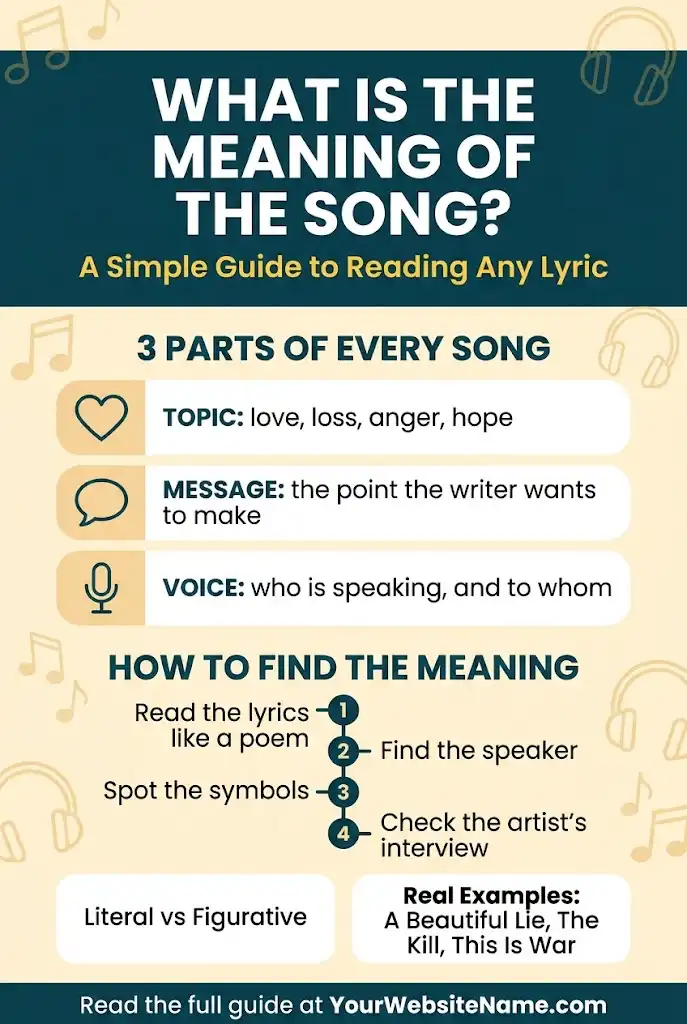
The meaning of the song is the idea behind it. Imagine a song as a mini-story with a mood. The words give the plot, while the music gives the mood. When they work together, they leave you with a feeling or a point.
Every song has three parts:
- A topic: love, loss, anger, money, home, faith, growing up.
- The message: the point the writer wants to get across, or the feeling they want you to have about the topic.
- The voice: who is doing the “talking” in the song, and who they are talking to.
Here is the part most sites miss. The writer’s meaning and your meaning can differ, and both are real. For instance, a breakup song can become a comfort song for someone who never had a breakup. You are not wrong for that, because it simply means the song worked.
What Is Lyrics in a Song?
People often ask, “What is lyrics in a song?” Lyrics are the words that are sung or rapped. The tune, on the other hand, is the melody. Lyrics are the text.
Lyrics are not the same as the meaning of the song. They are the raw material, and it is up to you to build meaning from them. Likewise, two songs can have the same words and still sound very different because of tone, tempo, and the singer’s voice.
A song lyrics analysis is simply a careful reading of the words, followed by questions. What does it do? Who is speaking? What do they want? Finally, what changed between the first verse and the last?
Little hint: if you only remember a few words of a song, searches like “is this is lyrics” or “who knows lyrics” are common guesses. In that case, type exactly what you recall, then add the word “lyrics” after it. The song usually shows up fast that way.
Why Do Songs Have Hidden Meanings?
Songs are about three minutes long. That is not much room, so writers pack a lot into a few lines. Instead of long explanations, they use pictures.
There are a few common reasons for hidden meaning:
- Space. One strong picture can take the place of a paragraph.
- Safety. Some topics are hard to say out loud, so a metaphor makes them easier.
- Rule-bending. For centuries, protest songs have hidden their real targets.
- Art. Plain words are rarely as powerful as clever ones.
For this reason, songs with meaning stick with us. After all, a song that has a meaning beyond the surface gives you something new each time you listen.
How Do You Find the Meaning of a Song?
You do not need a music degree. Here is a simple method for the interpretation of song lyrics.
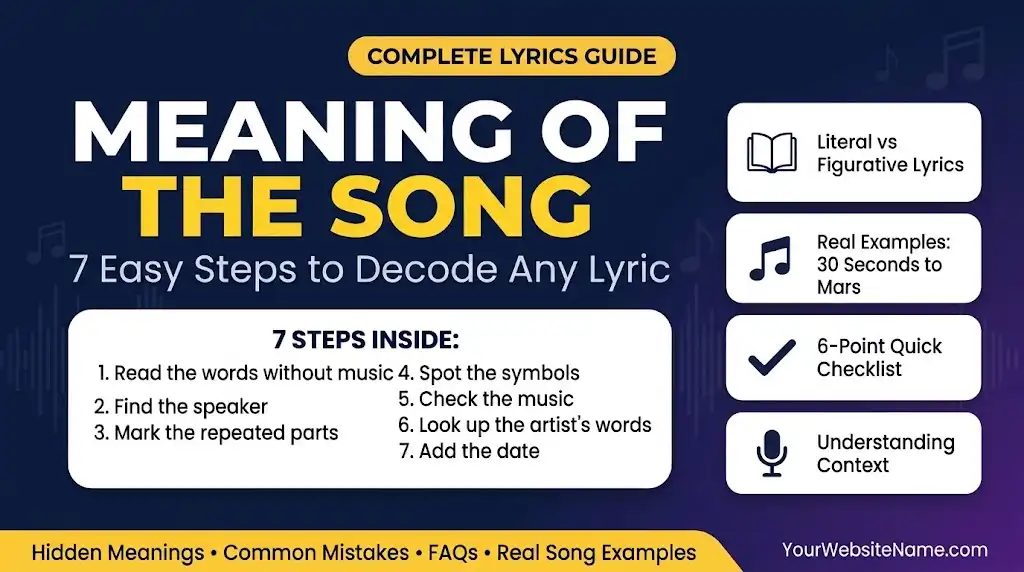
- Read the words without the music. Treat them like a short poem. What is the story?
- Find the speaker. Is it the artist, a character, or a made-up person?
- Mark the repeated parts. The chorus is usually the central idea.
- Spot the pictures. Look for words that stand for something else, like rain, fire, or a closed door.
- Check the music. A sad line over a happy beat means something, and so does the opposite.
- Look up the artist’s own words. Interviews, liner notes, and behind-the-scenes videos are the best proof.
- Add the date. When did the song come out, and what was going on in the world or in the writer’s life?
| Step | What to Check | Why It Helps |
|---|---|---|
| Read the words | Lyrics without music | Shows the plain story |
| Find the speaker | Who is talking | Shows the point of view |
| Mark repeats | Chorus and hooks | Shows the main idea |
| Spot symbols | Rain, fire, numbers | Shows hidden meaning |
| Check the artist | Interviews, notes | Gives real proof |
The sixth step is the one that settles arguments. Opinions are fine, but the writer’s own words count the most.
What Is the Difference Between Literal and Figurative Lyrics?
Literal lyrics say exactly what they mean. “I’m walking home in the rain” describes someone walking home in the rain.
Figurative lyrics, however, talk about one thing to mean another. “I’m drowning” might mean the person feels overwhelmed, not that they are in water.
Most songs mix both. A good habit is to read each line twice. First, read it as plain words. Then ask, “Could this stand for something bigger?”
A line that mentions a sign, a number, or a pattern that keeps coming back may be using symbols. Angel numbers such as 444 and the 1111 angel number often show up in lyrics, titles, and fan theories because many people see them as signs. If you meet one in a song, look up what it stands for first, then read the line.
Who Knows What a Song Really Means?
A fair question. Who knows the true meaning of the lyrics? The honest answer: the writer knows the most, but not always everything. In fact, writers often say they wrote a line by instinct and understood it later.
Here is the order of trust, from strongest to weakest:
- The writer’s own words in an interview or note.
- Other people who helped make the song, like the producer or band.
- Music journalists who covered the release.
- Your own careful reading.
- Random guesses and theories online.
Crowd-written notes on lyric sites can be fun. Still, treat them as ideas, not facts.
Next, let’s use this order on real songs.
Real Examples: The Meaning of the Song in Action
The Meaning of the Song “A Beautiful Lie”
“A Beautiful Lie” is a song by 30 Seconds to Mars. It is the title track of their 2005 album and came out as a single in 2007.
The title already tells you a lot. A lie is normally a bad thing, so calling it beautiful creates tension. Why would anyone want to believe something false?
The It’s a Beautiful Lie lyrics are often read as being about self-deception. We tell ourselves comforting stories to get through hard times, and the song asks whether those stories help us or hold us back. That is one fair reading, not the only one.
The music video adds more. It was filmed in the Arctic, with huge, empty ice around the band. In addition, the wide, cold, lonely scenery matches the idea of facing the truth with nowhere to run. That is the kind of clue steps five and seven point to.
Notice what we did. We did not need a secret code. Instead, we read the title, found the speaker’s problem, and checked the video.
What Does “The Kill” Tell Us About Artist Intent?
Another song on the same album is “The Kill.” Fans debated it for years. Some heard a breakup, while others heard something else.
Singer Jared Leto settled part of the debate. He said the song is “really about a relationship with yourself.” That one line changes the chorus, since the “other person” may be the speaker’s own darker side.
That is why step six matters. Without the comment, the breakup reading looks just as good. With it, however, you have proof.
Is “This Is War” About a Real War?
Many people search for the song “This Is War” lyrics and ask whether the song is about an actual war. It comes from the 2009 album of the same name by 30 Seconds to Mars.
Most listeners hear it as a call to fight for yourself, your art, and your freedom, not a song about soldiers. Meanwhile, the band was also in a public fight with its record label around that time, and many fans link that fight to the title and mood. Treat that link as context, not as a rule.
So when you read the This Is War lyrics, ask the big questions. Who is the enemy? Is it a person, a system, or a fear? The answer can change from person to person, and that is fine.
| Song | Album | Common Reading |
|---|---|---|
| A Beautiful Lie | A Beautiful Lie | Self-deception |
| The Kill | A Beautiful Lie | A fight with yourself |
| This Is War | This Is War | Fighting for yourself |
What Do Songs Mean to Us? Common Themes
If you wonder, “What do songs mean in general?” the answer is that most songs fall into a handful of families. Once you know them, you can read almost any lyric.
Love and heartbreak. The oldest theme. Notice who is leaving and who is staying.
Protest and politics. These songs push back against power. A line can point to a leader, a law, or a movement. The word fascist appears in protest songs, and its force changes depending on who is singing and who is listening. Understanding the word more fully shows you who the writer is aiming at.
Self-doubt and growth. Songs like “The Kill,” about fighting your own mind, belong here.
Hope and rebirth. These start in the dark and end with a turn upward.
Fear of missing out. Many pop and hip-hop songs are about wanting what others seem to have. It is a close cousin to FOMO, and lyrics are often a way to face it.
| Theme | Look For | Typical Mood |
|---|---|---|
| Love and loss | Who leaves, who stays | Sad or warm |
| Protest | Named targets, slogans | Angry, bold |
| Self-doubt | Inner voice, mirrors | Tense, honest |
| Hope | Dark start, bright end | Uplifting |
Can a Song Have More Than One Meaning?
Yes, and good songs usually do. There are three levels:
- What the writer meant.
- Which readings the words allow, since some fit the text and others do not.
- Your own reading, which depends on your own life.
Your reading is valid as long as the lyrics support it. However, it is weaker if you have to ignore half the song to make it work.
Common Mistakes When Reading Lyrics
- Mishearing the words. Always check the lyrics on a trusted source, because one wrong word can flip the mood.
- Hunting for one true meaning. Many songs hold more than one.
- Ignoring the music. Tone and tempo are part of the message.
- Believing every theory. If there is no quote or source, call it a theory.
- Reading old songs by new rules. Words change, so a phrase can mean something different now than when the song was written.
Quick Checklist for Any Song
Before you decide on the meaning of the song, ask:
- Who is speaking?
- What is the main mood?
- Which lines repeat?
- Which images stand for something else?
- Does the music match the words or fight them?
- What did the artist say about it?
If you can answer four of these six, you have a strong reading.
FAQs About the Meaning of the Song
What is the meaning of the song?
The meaning of the song is the message, story, or feeling the writer puts into the words and music. It includes what the lyrics say and what they point to underneath.
What is lyrics in a song?
Lyrics are the words that are sung or rapped in a song. They are separate from the tune. Meaning comes from reading the words together with the music.
How do I find out what a song means?
Read the lyrics like a short poem, find the speaker, mark the repeated parts, and spot the symbols. Then check interviews or notes from the artist for proof.
Can a song have more than one meaning?
Yes. What one person hears can be very different from what the writer meant. If the words support the reading, it is a stronger one.
What is the meaning of “A Beautiful Lie” by 30 Seconds to Mars?
Many listeners hear it as a song about self-deception, where comforting lies can keep us going but also keep us stuck. The band has not limited it to one reading.
Is “This Is War” about a real war?
Most listeners hear it as a call to fight for yourself, not a song about soldiers. The band was also in a public fight with its record label at the time, which many fans link to the song.
Final Take on the Meaning of the Song
A song lives in three places: the words, the sound, and the listener. Start with the lyrics, test your idea against the music, and back it up with what the artist has said. If those three agree, you have a good reading. If they do not, keep listening, because great songs are worth a second and third play.
Want to go deeper? Check the exact words on a trusted lyrics site like Genius, and compare what you hear with the artist’s own notes and interviews.