
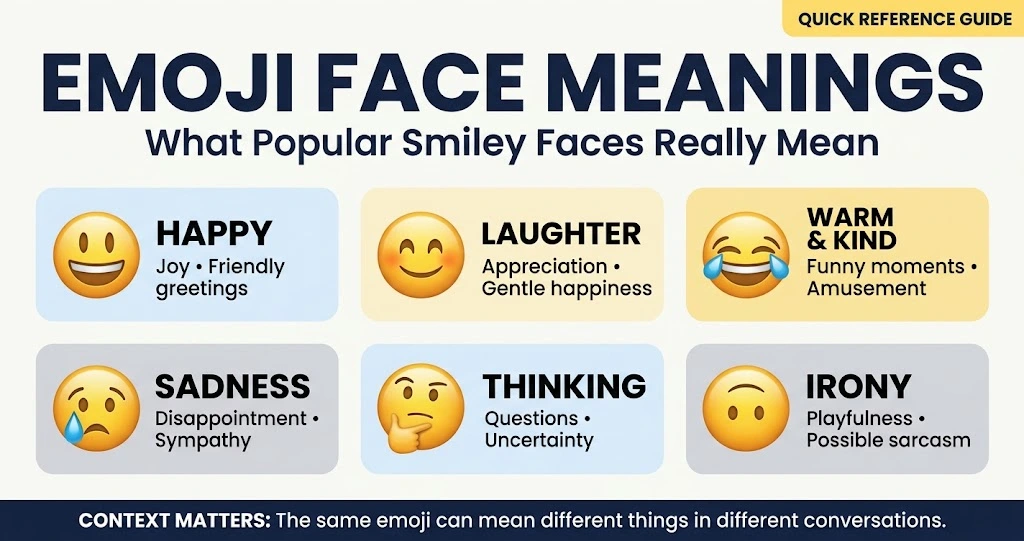
Understanding emoji face meanings is simple: 😊 means genuine warmth, 🙂 often means polite or passive-aggressive, and 🙃 means sarcasm or irony. One wrong smiley can change your whole message tone. In digital communication, emojis have effectively replaced physical facial expressions, tone of voice, and body language.
Because text messages lack vocal cues, picking the wrong smiling emoji can instantly change the tone of your message. Are you unsure whether a slight smile signals friendliness or passive-aggressive coldness? This comprehensive guide breaks down popular emoji face meanings, explains subtle tone shifts between similar icons, and shows you how to use them accurately across texting and social media.
Quick Reference: Top Emoji Face Meanings and Core Tones
When you need to decode a message quickly, understanding the baseline emotional category of a smiley face is the best starting point. Below is a clean, mobile-friendly guide to the three most frequently misinterpreted smileys and their core emoji face meanings.
-
Warm Smile Emoji (😊): Communicates genuine warmth, sincere appreciation, and comfort.
-
Slight Smile Emoji (🙂): Communicates polite restraint, formal distance, or subtle passive-aggressiveness.
-
Upside-Down Face Emoji (🙃): Communicates irony, sarcasm, self-deprecating humor, or awkward situations.
Similar Emojis, Different Meanings: How to Spot Tone Shifts
The biggest cause of confusion in modern texting is not the obvious emojis, but the subtle variations between similar-looking faces. Understanding these small visual differences helps prevent accidental miscommunication.
Warm Smile vs Slight Smile: Emoji Face Meanings Explained
While both icons feature a smile emoji design, their emotional undertones and emoji face meanings are quite different:
-
Warm Smile Emoji (😊): Features blushed cheeks and crinkled eyes, signifying genuine warmth, appreciation, and comfort.
-
Slight Smile Emoji (🙂): Features an unmoving, neutral eye expression paired with a flat mouth curve. In modern texting—especially among younger generations—this emoji is often interpreted as polite restraint, artificial cheerfulness, or passive-aggressive distance.
Simple Smile vs Upside Down Face: Politeness vs Sarcasm Explained
When comparing polite communication to ironic subtext:
-
Slight Smile Emoji (🙂): Used when trying to remain polite or formal in casual conversation.
-
Upside-Down Face Emoji (🙃): Literally turns happiness on its head. It communicates self-deprecating humor, irony, or coping with minor bad luck (e.g., “Stuck in traffic for two hours 🙃”).
How Context and Text Pairings Change an Emoji’s Meaning
An emoji rarely sits by itself; its emoji meaning depends directly on the words paired with it, the relationship between speakers, and the platform being used.
Real-Life Text Scenarios
Notice how changing the emoji at the end of the exact same sentence alters the entire message tone:
-
“Thanks for helping me today 😊”
Tone: Sincere, warm, and genuinely grateful.
-
“Thanks for helping me today 🙂”
Tone: Formal, somewhat distant, or mildly polite.
-
“Thanks for helping me today 🙃”
Tone: Sarcastic or referencing a chaotic/stressful situation you worked through together.
Social Media Trends and Generational Differences
On social media platforms like TikTok, Instagram, and X (formerly Twitter), emoji culture evolves rapidly:
-
Generational Interpretation: Gen Z users frequently view the standard slightly smiling face (🙂) as cold or dismissive, whereas Older Millennials and Gen X use it simply as a polite nod.
-
Seasonal & Event Context: Context dictates tone during celebrations. For example, when sending a happy birthday message on social media, combining an upbeat smile emoji (😊) with party icons ensures your message feels energetic and celebratory rather than transactional.
Frequently Asked Questions About Emoji Face Meanings
How do I choose the right emoji for social media vs professional chats?
In professional environments (like Slack or Microsoft Teams), stick to unambiguous, warm emojis like 😊 or standard thumbs-up icons. Avoid ambiguous icons like 🙃 or 🙂, which can be easily misread as sarcastic by coworkers. On casual social media platforms, freer expression and ironic usage are widely accepted.
Which smile emoji is best for wishing a happy birthday?
For greetings like happy birthday, combine the Warm Smile Emoji (😊) with celebration emojis like 🎂 or 🎉. This communicates genuine happiness and festive enthusiasm.
Why do emojis look different on iPhone vs Android?
Emojis are part of the standardized Unicode system, but each operating system designer (Apple, Google, Samsung) customizes the visual artwork. A face icon created on iOS might have slightly wider eyes or a different mouth curve on Android, which can occasionally shift the perceived emotion.
Key Takeaways for Everyday Texting
-
Match your emoji to your intended emotional tone—use 😊 for real warmth and 🙃 for clear irony.
-
Avoid relying on 🙂 if you want to sound enthusiastic or friendly, as it can read as distant.
-
Always read the text and emoji together to make sure your message comes across correctly.
Conclusion: How to Choose the Right Emoji
In digital communication, a single smiley face can completely transform the tone of your message. Decoding emoji face meanings helps you avoid awkward texting mishaps. For genuine warmth and friendliness, 😊 is your best choice, whereas 🙂 can easily come across as cold or overly formal. If you want to convey irony, sarcasm, or lighthearted frustration, 🙃 gets the job done perfectly.
Always align your emoji choice with the surrounding context and your relationship with the recipient. Taking a quick second to match the right smiley with your words ensures your message lands exactly as intended without awkward misinterpretation. For more helpful guides on digital subtext, modern texting etiquette, and everyday communication, explore QuoteofFame.