
Your cat’s tail is one of the clearest ways she tells you how she feels. A tail held high, a slow swish or a sudden puff can all mean very different things. Learning cat tail meanings helps you notice happiness, irritation and fear early, before a cuddle turns into a scratch.
The tricky part is that cat tail language doesn’t work like a dog’s. Many people see a moving tail and assume the cat is happy, and that guess is often wrong. The same movement can mean two opposite things depending on what the rest of the body is doing.
Are you staring at your cat’s tail right now, wondering what it means? Maybe it’s twitching while you pet her. Maybe it’s puffed up, or wrapped around your arm, and you can’t tell if that is love or a warning. This guide explains cat tail meanings step by step: how to read the tail, why cats wag it, whether they do it on purpose, and when it is a sign to give space or call a vet.
Quick answer: When a cat wags her tail, it usually signals some level of agitation, focus or excitement, not the simple happiness a dog’s wag often shows. A tail held up is generally friendly, while a low, tucked or lashing tail suggests unease or irritation. Always check the ears, eyes and body before you decide.
How to Read Cat Tail Meanings in 3 Steps
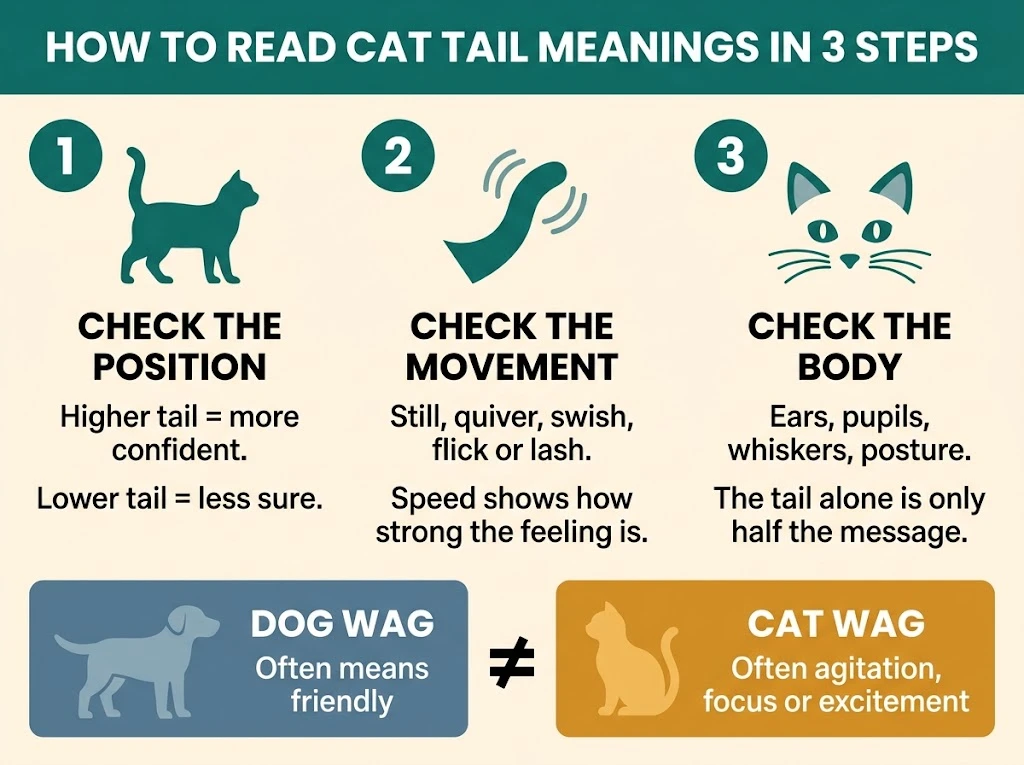
If you only remember one thing from this article, remember this order. It stops you from reacting to one signal on its own.
- Check the position. Where is the tail being held: up, low, wrapped or tucked? As a general rule, the higher the tail, the more confident and comfortable the cat tends to be. A lower tail suggests she is less sure of things.
- Check the movement. Is it still, quivering, swishing slowly, flicking fast or lashing? Speed and size of the movement tell you how intense the feeling is.
- Check the rest of the body. Ears, pupils, whiskers and posture decide the final meaning. A tail signal on its own is only half the message.
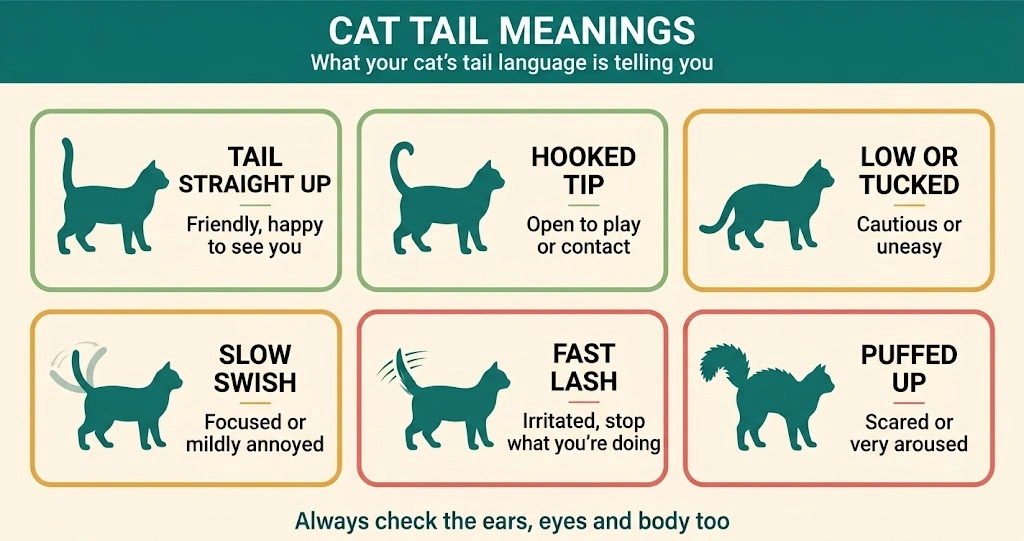
Here is a quick reference you can scan:
| Tail signal | What it often means | What to do |
|---|---|---|
| Held straight up, tip may quiver | Friendly, happy to see you | Greet her, she is open to contact |
| Upright with a hooked tip | Friendly and open to interaction | Good moment to say hello or play |
| Low or tucked | Cautious, uneasy or protecting herself | Give space, don’t crowd her |
| Slow swish | Focused on something, or mildly annoyed | Look at the context before acting |
| Fast thump or lash | Irritated, wants you to stop | Stop what you’re doing |
| Puffed up | Frightened, or very aroused | Back off and let her settle |
These cat tail meanings are common patterns, not rules. Individual cats differ, so use the table as a starting point, not a verdict.
Cat Tail Meanings by Position: What Each One Says
Position tells you the general mood, so these cat tail meanings are the best place to start. Movement then tells you how strong the feeling is.
Friendly Cat Tail Meanings: Straight Up or Hooked
This is the position most owners hope to see. A tail held upright is a friendly signal that says the cat is open to contact. If the tip curls over like a question mark, that is often read as an invitation to interact or play. Cats also use this position when greeting another cat they know, which is why you may see it when you walk through the door.
Low or Tucked Tail
A tail held low, or tucked in close, usually points to caution, uneasiness or a wish to look small and stay unnoticed. You may see a hunched body or ears turned sideways as well. In that case, don’t reach for her. Let her come to you.
One caution: a low tail is not always a bad sign. Some breeds, such as Persians, naturally carry their tails lower, and a cat getting ready for a nap may drop her tail simply because she is relaxed.
Tail Wrapped Around You or Another Cat
When your cat wraps her tail around your leg or arm, it is generally a friendly gesture, similar to putting an arm around someone. Cats that are close friends may even twine their tails together.
Don’t treat it as permission for a long cuddle, though. She might want to be near you without wanting to be held.
Why Do Cats Wag Their Tails? The Cat Tail Meanings Behind the Wag
Of all cat tail meanings, the wag is the one people get wrong most often. In dogs, a wagging tail is often read as friendliness. Behaviorists note that the equivalent movement in cats usually isn’t friendly. A cat’s wag more often reflects arousal of some kind: concentration, irritation or conflicted feelings.
So when you ask what it means when a cat wags its tail, the honest answer is: it depends on the speed, the position and the situation. These are the most common patterns.
Slow Swish vs Quick Swish
A slow swish from side to side often shows a cat concentrating on something, such as a toy or a bird at the window, and she may be about to pounce. The same slow swish can also mean mild annoyance, for example when dinner is late or she isn’t getting the attention she wants.
A quick swish with the tail held high is more often playful. The tail position is the clue that separates it from an angry flick.
Flick, Thump and Lash
A small, quick flick at the tip is an early warning. Think of it as a cat’s version of tapping fingers: she is irritated but hasn’t decided to act. A short twitch at the very end can also appear when she is hunting a toy, so check the situation first.
A thump, slap or hard lash means she is clearly annoyed or uncertain. Some cats go from mild lashing straight to a swat with very little warning, while others thrash hard and never swat. Since you can’t know which kind you have, stop petting, give her space and look for what is bothering her.
Quiver
A tail held high with the tip quivering is usually a happy, excited greeting, often with head-butts and purring. It is worth knowing that quivering can occasionally mean something else, which the FAQ below covers.
Do Cats Control Their Tails?
Yes, to a large degree, but not completely. A cat’s tail is made up of a chain of small bones surrounded by muscles, which lets it move in many ways. Experts describe most tail movement as voluntary, with some parts being automatic reactions. How much is deliberate is not fully settled, so treat any exact split as an interpretation, not a proven fact.
Voluntary Movements
These are the ones cats appear to choose: raising the tail in greeting, wrapping it around you, or brushing it against your leg as she walks past, which is generally taken as a sign of affection. Position tends to be more deliberate than small movements.
Tails also help with balance. A cat walking along a narrow fence uses her tail to counterweight her body.
Involuntary Reactions
Some tail behavior happens without a decision. When a cat is frightened, the fur on the tail can bristle and make it look much bigger, a reflex called piloerection. It often appears with an arched back and wide pupils.
Another common reflex is the sleep twitch. A cat that is dozing may flick her tail when you speak to her or come near, as if saying a quick hello without waking up.
Puffing is not always fear. A very excited, playful cat may puff her tail just before pouncing, so read the situation, not just the fur.
When Do Cat Tail Meanings Point to Pain or Illness?
Most tail signals are just emotions. Occasionally, though, the tail points to a physical problem. Watch for these.
- A tail that hangs limp or sits in an odd position. A cat’s tail is an extension of her spine and can be injured or even fractured. If she also cries out or avoids being touched, take it seriously.
- A cat lying down and waving her tail, along with other changes. This can mean she is unwell, especially if she is hiding more or not eating.
- A tail held low in a crouch, with other signs of illness. A tail wrapped around the body is a normal resting position for many cats, so only worry when it appears together with changes in eating, drinking or toileting.
This article is general information, not veterinary advice. If a tail change is sudden, persistent or comes with pain or behavior changes, see a vet.
Is It OK to Touch a Cat’s Tail?
It’s best to be careful. Cats do touch you with their tails, but that doesn’t mean they want you to touch them back. The tail is part of the body, like a leg, and grabbing or holding it can be very stressful for a cat.
If a cat taps you with her tail or hits you with it, treat it as a sign to look for what is bothering her. If her tail is wrapped around you in a calm, friendly way, a gentle stroke elsewhere is usually fine, but stop the moment she tenses, swats or goes quiet.
Frequently Asked Questions
How do cats without tails communicate?
Cats with missing or very short tails, such as Manx and bobtail breeds, use other signals. These include eye contact, ear positions, sounds like hissing or trilling, back and shoulder posture and even scent.
Why does my cat quiver her tail and back up to a wall?
Usually a quivering tail is a happy greeting. But if a cat holds her tail up, quivers it and then backs against a vertical surface like a wall, she may be about to spray urine to mark territory. If this happens in your home, speak to a vet or a cat behaviorist.
Do some cats naturally carry their tails low?
Yes. Some breeds, such as Persians, tend to carry their tails lower than others, so a low tail on its own isn’t a reliable sign of fear. Look at the rest of her body to decide.
Conclusion
You started with a simple problem: your cat’s tail was doing something and you didn’t know what it meant. The key points are these. A cat’s wag is not a dog’s wag, so don’t assume a moving tail means happiness. Read position first, movement second and the whole body third. A raised tail is usually friendly, a lashing or puffed tail means back off, and a limp or oddly held tail that comes with other changes deserves a vet’s attention.
Once you know cat tail meanings, the next time you see that tail moving you’ll know what to check and what to do: give space when she is irritated, welcome her when she is open, and watch for health changes. That is really all cat tail language comes down to.
If you want to keep learning, two good next reads are Catster’s vet-reviewed guide to cat tail language, which comes with helpful infographics, and Rover’s breakdown of cat tail positions and movements, which includes advice from a veterinarian and feline behaviorists. Reading how different experts describe the same signals will make your own observations of your cat even sharper.