

The RSVP meaning is simple: it means “please reply” or “please respond.” You may see RSVP on wedding cards, party invitations, dinner invitations, and other events where the host needs to know who plans to attend.
RSVP comes from the French phrase “répondez s’il vous plaît,” which means “please respond.” When an invitation asks you to RSVP, the host is asking you to confirm whether you will attend, usually by a specific date.
What Does RSVP Mean?
The RSVP meaning comes from the French expression “répondez s’il vous plaît.” In English, this translates to “please reply” or “please respond.”
On an invitation, RSVP is a request for a response from the invited person. The host generally wants to know whether you plan to attend.
For example, if an invitation says:
RSVP by October 15
the host wants you to tell them by October 15 whether you will attend.
Your response may be an acceptance or a decline, depending on your plans and the instructions provided on the invitation.
What Does “Répondez S’il Vous Plaît” Mean?
The French phrase can be understood word by word:
- Répondez = respond or reply
- S’il vous plaît = please
Together, “répondez s’il vous plaît” means “please respond.”
The abbreviation RSVP became a widely recognized part of invitation language. Today, you do not need to speak French to understand it. When you see RSVP on an invitation, the practical meaning is simple: the host wants you to reply.
What Does RSVP Mean on a Wedding Card?
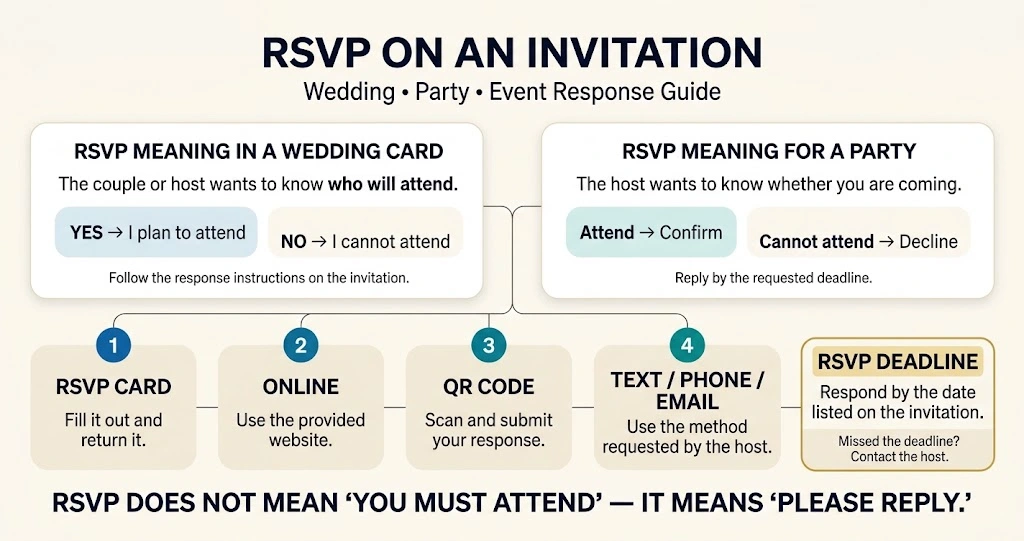
If you are searching for the RSVP meaning in wedding card, the basic meaning is the same: the couple wants you to confirm whether you will attend the wedding or related event.
Wedding invitations often include an RSVP card, website, QR code, phone number, email address, or another response method.
For example, a wedding invitation might say:
RSVP by May 20
This means you should provide your response no later than May 20.
A wedding RSVP may ask for more than a simple yes or no. Depending on the event, you may be asked to provide:
- Your name
- Whether you will attend
- The number of guests attending
- Names of additional guests, if permitted
- Meal preferences
- Other requested information
The exact questions depend on the couple and the type of wedding.
Does a Wedding RSVP Mean You Have to Attend?
No. RSVP does not mean that you must attend.
It means that the host wants you to respond.
If you can attend, you can accept the invitation according to the instructions. If you cannot attend, you can decline it.
The important point is to give the host an accurate response so they can plan the event properly.
For a wedding, an accurate guest count can affect seating, meals, tables, venue arrangements, and other planning decisions.
What Does RSVP Mean on a Party Invitation?
The RSVP meaning party invitations use is essentially the same as on wedding invitations.
A party invitation may say:
Please RSVP by August 5.
The host is asking you to confirm whether you plan to attend.
RSVP can appear on many types of party invitations, including:
- Birthday parties
- Dinner parties
- Anniversary celebrations
- Graduation parties
- Holiday gatherings
- Engagement parties
- Formal receptions
- Other social events
The reason for requesting an RSVP is usually practical. The host may need to know approximately how many people will attend so they can arrange food, seating, space, activities, or other details.
So, if you were wondering what is RSVP mean on a party invitation, the simple answer is: the host is asking you to reply and confirm your attendance.
What Information Does an RSVP Usually Ask For?
An RSVP does not always ask for the same information. The invitation normally tells you exactly what the host needs.
A basic RSVP may only ask:
Will you attend? Yes / No
A more detailed RSVP might ask for:
- Your full name
- Attendance confirmation
- Number of guests
- Names of guests
- Meal selection
- Dietary requirements
- Contact information
- Other event-specific preferences
For example:
Will you attend?
☐ Yes
☐ No
Or an online RSVP form might ask:
Name:
Attending: Yes / No
Number of guests: 2
Meal preference: Vegetarian
The safest approach is to answer the questions that are actually included in the invitation rather than assuming what the host wants.
How Do You RSVP to an Invitation?
Once you understand the RSVP meaning, the next question is usually: How do I actually respond?
The invitation should tell you the preferred response method. Follow those instructions rather than choosing a different method unless necessary.
How to RSVP by Card
Traditional invitations may include a separate RSVP card.
You may need to:
- Fill in your name.
- Select whether you will attend.
- Provide any requested guest information.
- Select a meal option if applicable.
- Return the card using the provided envelope.
Read the card carefully because the host may have specific instructions.
How to RSVP Online or by QR Code
Many modern invitations use an event website or QR code.
You may scan the QR code, open the provided website, and complete an RSVP form.
The form may ask for your name, attendance status, guest count, meal choice, or other information.
Before submitting the form, check that your answers are correct.
How to RSVP by Text, Phone, or Email
Some informal or smaller events may ask guests to RSVP by text message, phone, or email.
For example, an invitation might say:
RSVP to Sarah at the number provided.
In that situation, send a clear response such as:
“Hi Sarah, thank you for the invitation. I’ll be attending.”
If you cannot attend, clearly let the host know rather than leaving the invitation unanswered.
What Does the RSVP Deadline Mean?
An RSVP deadline is the date by which the host wants to receive your response.
For example:
RSVP by September 10
means you should respond on or before September 10.
The deadline helps the host finalize arrangements. Depending on the event, the host may need the final guest count for:
- Food and catering
- Seating
- Tables
- Venue capacity
- Printed materials
- Event activities
- Accommodation arrangements
There is no single universal RSVP deadline that applies to every invitation. The date printed on the invitation is the one you should follow.
What If You Miss the RSVP Deadline?
If you missed the deadline, do not assume that you are automatically unable to attend.
Contact the host as soon as possible and explain that you are responding late.
The host may still be able to accommodate you, but that depends on the event and how far planning has progressed.
What If You Cannot Attend After Receiving an RSVP Request?
If you cannot attend, an RSVP still gives you a reason to respond.
A simple decline can be enough:
“Thank you for the invitation. Unfortunately, I won’t be able to attend, but I appreciate you thinking of me.”
You do not normally need to provide a long explanation unless the situation calls for one.
The main goal is to give the host an accurate answer.
Ignoring an RSVP request can create uncertainty because the host may not know whether you are attending or simply forgot to respond.
Common RSVP Wording and What It Means
Invitation wording can sometimes make RSVP confusing. Here are some common examples.
What Does “Kindly RSVP” Mean?
This means:
Please respond to the invitation.
The invitation should provide a response method or contact information.
What Does “RSVP by June 15” Mean?
This means:
Send your response no later than June 15.
The host has set June 15 as the requested deadline.
What Does “RSVP: Yes / No” Mean?
This means:
Tell the host whether you will attend or will not attend.
What Does “Please RSVP Online” Mean?
This means:
Use the website or online form provided by the host to submit your response.
What Does “RSVP via QR Code” Mean?
This means:
Scan the QR code and follow the instructions to confirm your attendance.
What Does “Regrets Only” Mean?
This wording is slightly different.
“Regrets only” generally means you should contact the host only if you cannot attend. If you plan to attend, no separate acceptance response is normally required.
However, always follow the specific instructions on the invitation because event organizers may use different wording or procedures.
RSVP Examples: Understanding Common Invitation Wording
Seeing RSVP in context can make the meaning easier to understand.
Example 1: Wedding RSVP
“Please RSVP by April 12.”
Meaning: The couple wants you to confirm whether you will attend by April 12.
Example 2: Party RSVP
“Kindly RSVP to Mark by Friday.”
Meaning: Mark wants you to let him know whether you plan to attend the birthday party.
Example 3: Online RSVP
“RSVP using the link below.”
Meaning: Go to the provided website and submit your attendance response.
Example 4: QR Code RSVP
“Scan to RSVP.”
Meaning: Scan the QR code and complete the provided response process.
Example 5: Regrets-Only RSVP
“RSVP regrets only.”
Meaning: Contact the host if you cannot attend. If you plan to attend, the invitation generally does not require a separate acceptance response.
Frequently Asked Questions About RSVP
Is RSVP a French word?
RSVP is an abbreviation of the French phrase “répondez s’il vous plaît,” meaning “please respond” or “please reply.”
Does RSVP mean yes or no?
No. RSVP means that the host wants a response. Your response may be yes or no, depending on whether you plan to attend and what the invitation requests.
Can RSVP be used as a verb?
Yes. People commonly say things such as “Please RSVP” or “I need to RSVP to the invitation.” In these cases, RSVP means to provide the requested response.
What happens if you do not RSVP?
If an invitation requests an RSVP and you do not respond, the host may not know whether you are coming. This can make it harder to plan seating, food, or other arrangements.
Does RSVP include a plus-one?
Not automatically. A guest or plus-one is allowed only when the invitation or host indicates that you may bring one. If you are unsure, ask the host rather than assuming.
Is RSVP required for every invitation?
No. Only RSVP when the invitation requests a response or provides RSVP instructions. If an invitation says “regrets only,” follow that specific instruction instead.
What RSVP Really Means
The simplest RSVP meaning is “please reply.”
The phrase comes from the French “répondez s’il vous plaît” and is used on invitations when a host needs to know whether guests plan to attend.
Whether you see RSVP on a wedding card, party invitation, dinner invitation, or another event, the practical step is the same: read the instructions, respond using the requested method, and meet the stated deadline.
If you can attend, confirm your attendance. If you cannot, let the host know. If the invitation asks for additional information such as guest numbers or meal choices, provide that information accurately.
Once you understand this, RSVP is no longer confusing: it is simply the invitation’s way of asking you to reply.
The RSVP meaning comes from the French expression “répondez s’il vous plaît.” In English, this translates to “please reply” or “please respond.”
On an invitation, RSVP is not simply extra wording. It is a request for a response from the invited person.
For example, if an invitation says:
RSVP by October 15
the host wants you to tell them by October 15 whether you will attend.
Your response may be an acceptance or a decline, depending on your plans and the instructions provided on the invitation.
What Does “Répondez S’il Vous Plaît” Mean?
The French phrase can be understood word by word:
- Répondez = respond or reply
- S’il vous plaît = please
Together, “répondez s’il vous plaît” means “please respond.”
The abbreviation RSVP became a widely recognized part of invitation language. Today, you do not need to speak French to understand it. When you see RSVP on an invitation, the practical meaning is simple: the host wants you to reply.
What Does RSVP Mean on a Wedding Card?
If you are searching for the RSVP meaning in wedding card, the basic meaning is the same: the couple wants you to confirm whether you will attend the wedding or related event.
Wedding invitations often include an RSVP card, website, QR code, phone number, email address, or another response method.
For example, a wedding invitation might say:
RSVP by May 20
This means you should provide your response no later than May 20.
A wedding RSVP may ask for more than a simple yes or no. Depending on the event, you may be asked to provide:
- Your name
- Whether you will attend
- The number of guests attending
- Names of additional guests, if permitted
- Meal preferences
- Other requested information
The exact questions depend on the couple and the type of wedding.
Does a Wedding RSVP Mean You Have to Attend?
No. RSVP does not mean that you must attend.
It means that the host wants you to respond.
If you can attend, you can accept the invitation according to the instructions. If you cannot attend, you can decline it.
The important point is to give the host an accurate response so they can plan the event properly.
For a wedding, an accurate guest count can affect seating, meals, tables, venue arrangements, and other planning decisions.
What Does RSVP Mean on a Party Invitation?
The RSVP meaning party invitations use is essentially the same as on wedding invitations.
A party invitation may say:
Please RSVP by August 5.
The host is asking you to confirm whether you plan to attend.
RSVP can appear on many types of party invitations, including:
- Birthday parties
- Dinner parties
- Anniversary celebrations
- Graduation parties
- Holiday gatherings
- Engagement parties
- Formal receptions
- Other social events
The reason for requesting an RSVP is usually practical. The host may need to know approximately how many people will attend so they can arrange food, seating, space, activities, or other details.
So, if you were wondering what is RSVP mean on a party invitation, the simple answer is: the host is asking you to reply and confirm your attendance.
What Information Does an RSVP Usually Ask For?
An RSVP does not always ask for the same information. The invitation normally tells you exactly what the host needs.
A basic RSVP may only ask:
Will you attend? Yes / No
A more detailed RSVP might ask for:
- Your full name
- Attendance confirmation
- Number of guests
- Names of guests
- Meal selection
- Dietary requirements
- Contact information
- Other event-specific preferences
For example:
Will you attend?
☐ Yes
☐ No
Or an online RSVP form might ask:
Name:
Attending: Yes / No
Number of guests: 2
Meal preference: Vegetarian
The safest approach is to answer the questions that are actually included in the invitation rather than assuming what the host wants.
How Do You RSVP to an Invitation?
Once you understand the RSVP meaning, the next question is usually: How do I actually respond?
The invitation should tell you the preferred response method. Follow those instructions rather than choosing a different method unless necessary.
RSVP by Card
Traditional invitations may include a separate RSVP card.
You may need to:
- Fill in your name.
- Select whether you will attend.
- Provide any requested guest information.
- Select a meal option if applicable.
- Return the card using the provided envelope.
Read the card carefully because the host may have specific instructions.
RSVP Online or by QR Code
Many modern invitations use an event website or QR code.
You may scan the QR code, open the provided website, and complete an RSVP form.
The form may ask for your name, attendance status, guest count, meal choice, or other information.
Before submitting the form, check that your answers are correct.
RSVP by Text, Phone, or Email
Some informal or smaller events may ask guests to RSVP by text message, phone, or email.
For example, an invitation might say:
RSVP to Sarah at the number provided.
In that situation, send a clear response such as:
“Hi Sarah, thank you for the invitation. I’ll be attending.”
If you cannot attend, clearly let the host know rather than leaving the invitation unanswered.
What Does the RSVP Deadline Mean?
An RSVP deadline is the date by which the host wants to receive your response.
For example:
RSVP by September 10
means you should respond on or before September 10.
The deadline helps the host finalize arrangements. Depending on the event, the host may need the final guest count for:
- Food and catering
- Seating
- Tables
- Venue capacity
- Printed materials
- Event activities
- Accommodation arrangements
There is no single universal RSVP deadline that applies to every invitation. The date printed on the invitation is the one you should follow.
What If You Miss the RSVP Deadline?
If you missed the deadline, do not assume that you are automatically unable to attend.
Contact the host as soon as possible and explain that you are responding late.
The host may still be able to accommodate you, but that depends on the event and how far planning has progressed.
What If You Cannot Attend the Event?
If you cannot attend, an RSVP still gives you a reason to respond.
A simple decline can be enough:
“Thank you for the invitation. Unfortunately, I won’t be able to attend, but I appreciate you thinking of me.”
You do not normally need to provide a long explanation unless the situation calls for one.
The main goal is to give the host an accurate answer.
Ignoring an RSVP request can create uncertainty because the host may not know whether you are attending or simply forgot to respond.
Common RSVP Wording and What It Means
Invitation wording can sometimes make RSVP confusing. Here are some common examples.
“Kindly RSVP”
This means:
Please respond to the invitation.
The invitation should provide a response method or contact information.
“RSVP by June 15”
This means:
Send your response no later than June 15.
The host has set June 15 as the requested deadline.
“RSVP: Yes / No”
This means:
Tell the host whether you will attend or will not attend.
“Please RSVP Online”
This means:
Use the website or online form provided by the host to submit your response.
“RSVP via QR Code”
This means:
Scan the QR code and follow the instructions to confirm your attendance.
“Regrets Only”
This wording is slightly different.
“Regrets only” generally means you should contact the host only if you cannot attend. If you plan to attend, no separate acceptance response is normally required.
However, always follow the specific instructions on the invitation because event organizers may use different wording or procedures.
Is RSVP Only Used for Weddings?
No. RSVP is not limited to weddings.
It can be used whenever an organizer needs guests to confirm attendance.
For example:
- A birthday party may request an RSVP to plan food.
- A dinner invitation may request an RSVP to reserve seats.
- A formal reception may need an accurate guest list.
- A graduation celebration may use an RSVP form to estimate attendance.
- A business or networking event may require registration before arrival.
The meaning remains essentially the same: please respond and tell the host whether you plan to attend, according to the invitation’s instructions.
RSVP Examples: Understanding Real Invitation Wording
Seeing RSVP in context can make the meaning easier to understand.
Example 1: Wedding
“Please RSVP by April 12.”
Meaning: The couple wants you to confirm whether you will attend by April 12.
Example 2: Birthday Party
“Kindly RSVP to Mark by Friday.”
Meaning: Mark wants you to let him know whether you plan to attend the birthday party.
Example 3: Online Event
“RSVP using the link below.”
Meaning: Go to the provided website and submit your attendance response.
Example 4: QR Code Invitation
“Scan to RSVP.”
Meaning: Scan the QR code and complete the provided response process.
Example 5: Regrets Only
“RSVP regrets only.”
Meaning: Contact the host if you cannot attend. If you plan to attend, the invitation generally does not require a separate acceptance response.
Frequently Asked Questions About RSVP
Is RSVP a French word?
RSVP is an abbreviation of the French phrase “répondez s’il vous plaît,” meaning “please respond” or “please reply.”
Does RSVP mean yes or no?
No. RSVP means that the host wants a response. Your response may be yes or no, depending on whether you plan to attend and what the invitation requests.
Can RSVP be used as a verb?
Yes. People commonly say things such as “Please RSVP” or “I need to RSVP to the invitation.” In these cases, RSVP means to provide the requested response.
What happens if you do not RSVP?
If an invitation requests an RSVP and you do not respond, the host may not know whether you are coming. This can make it harder to plan seating, food, or other arrangements.
Does RSVP include a plus-one?
Not automatically. A guest or plus-one is allowed only when the invitation or host indicates that you may bring one. If you are unsure, ask the host rather than assuming.
Is RSVP required for every invitation?
No. Only RSVP when the invitation requests a response or provides RSVP instructions. If an invitation says “regrets only,” follow that specific instruction instead.
What RSVP Really Means
The simplest RSVP meaning is “please reply.” The phrase comes from the French “répondez s’il vous plaît” and is used on invitations when a host needs to know whether guests plan to attend.
Whether you see RSVP on a wedding card, party invitation, dinner invitation, or another event, the practical step is the same: read the instructions, respond using the requested method, and meet the stated deadline.
If you can attend, confirm your attendance. If you cannot, let the host know. If the invitation asks for additional information such as guest numbers or meal choices, provide that information accurately.
For an authoritative dictionary definition and examples of how RSVP is used as an abbreviation, verb, and noun, you can also refer to the Cambridge Dictionary’s RSVP definition.
Once you understand this, RSVP is no longer confusing: it is simply the invitation’s way of asking you to reply.