
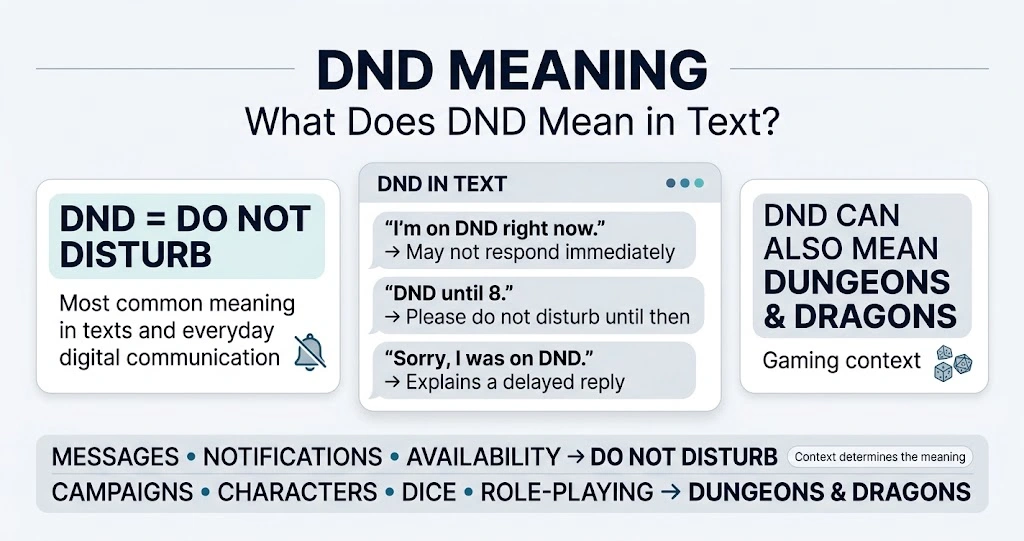
The dnd meaning is usually “Do Not Disturb,” especially when you see DND in a text message, social media conversation, or phone status. People use DND to show that they do not want interruptions, are temporarily unavailable, or may not respond immediately.
However, DND has more than one common meaning. In everyday digital communication, it usually refers to Do Not Disturb. In gaming conversations, the same abbreviation can mean Dungeons & Dragons. The surrounding context usually makes the intended meaning clear.
If you are wondering what DND means in a message, whether someone is ignoring you, or how you should respond, understanding the context will help you interpret it correctly.
What Is the DND Meaning?
The most common DND meaning is “Do Not Disturb.” The term can describe a person’s temporary unavailability or a device feature that reduces interruptions from calls, alerts, and notifications.
For example, someone might write:
“I’m on DND right now. I’ll reply later.”
Here, the sender means that they may not respond immediately because they are avoiding interruptions.
DND also has another widely recognized meaning: Dungeons & Dragons, the tabletop role-playing game. Gamers often use this meaning when they discuss campaigns, characters, dice, or role-playing.
Therefore, you should consider the surrounding conversation before deciding which DND meaning applies.
What Does DND Mean in Text?
The DND meaning in text normally refers to “Do Not Disturb.” A person may use the abbreviation to explain a delayed response or tell someone that they currently have limited availability.
Here are some common examples:
- “I’m on DND.” — The person may not respond immediately.
- “DND until 8.” — They prefer not to receive interruptions until that time.
- “Going on DND, talk later.” — They plan to step away from conversations.
- “Sorry, I was on DND.” — They are explaining a delayed response.
- “Please DND me for a while.” — They are asking someone not to disturb them.
Context still matters. Someone who uses DND does not necessarily feel angry, upset, or annoyed with a particular person.
Common DND Meaning Examples in Conversations
Examples make the DND meaning easier to understand in everyday conversations.
“I’m on DND right now”
This statement usually means the person wants fewer interruptions and may not check or answer messages immediately.
“DND until tomorrow”
The speaker wants to remain undisturbed until the stated time.
“Sorry for the late reply, I was on DND”
In this situation, the sender uses DND to explain why they did not respond earlier.
“Put your phone on DND”
Here, DND most likely refers to the phone’s Do Not Disturb feature rather than a simple texting abbreviation.
These examples show how the surrounding words can reveal the intended meaning.
How Is DND Used on Phones?
The DND meaning on a phone usually refers to the Do Not Disturb feature.
This setting helps people reduce interruptions from notifications, calls, and other alerts. Device manufacturers and operating systems can offer different controls, so the exact behavior may vary.
People commonly use DND while:
- Sleeping
- Studying
- Working
- Attending a meeting
- Driving
- Watching a movie
- Taking a break
- Focusing on an important task
DND can describe either a device setting or a person’s availability.
When DND refers to a phone feature, it controls interruptions and notifications.
When someone says “I’m on DND,” the person may simply mean that they are unavailable or do not want interruptions at that moment.
Because phone settings differ across devices, DND may not work exactly the same way everywhere.
What Does DND Mean on Social Media?
On social media, DND usually means “Do Not Disturb.” Depending on the platform, people may use it to describe a notification setting, a quiet period, or limited availability.
For example:
“I’m on DND for the rest of the evening.”
The statement communicates limited availability. It does not necessarily suggest that the person has a problem with anyone who sends a message.
Social platforms can handle DND features differently. For that reason, check the platform and surrounding conversation when you want to understand the exact meaning.
Does DND Mean Someone Is Ignoring You?
No. The DND meaning does not automatically indicate that someone is ignoring you.
A person may use DND while:
- Working
- Studying
- Sleeping
- Driving
- Attending a meeting
- Taking a break
- Concentrating on a task
- Avoiding general notifications
Consider this example:
“I’m on DND. I’ll get back to you later.”
The simplest interpretation is that the person currently has limited availability.
DND does not tell you whether someone feels angry, upset, or uninterested. It mainly communicates something about availability, not personal intentions.
What Should You Do When Someone Is on DND?
If the matter is not urgent, give the person some space and wait for a response.
For an urgent situation, use an appropriate communication method and clearly explain why you need an immediate response.
The best approach is to treat DND as an availability signal rather than assuming what the person thinks or feels.
How Should You Reply to Someone Using DND?
A short and respectful response usually works well when someone tells you that they are on DND.
You could reply:
- “No problem, talk later.”
- “Sure, take your time.”
- “Okay, message me when you’re free.”
- “Got it. I’ll talk to you later.”
When the person gives you a specific time, you can say:
“Okay, I’ll check back after 8.”
Urgent situations require a little more explanation. Tell the person why you need an immediate response instead of repeatedly sending ordinary messages.
Respecting someone’s DND status keeps the conversation simple and avoids unnecessary pressure.
DND Meaning vs. AFK, BRB, Silent Mode, and Offline
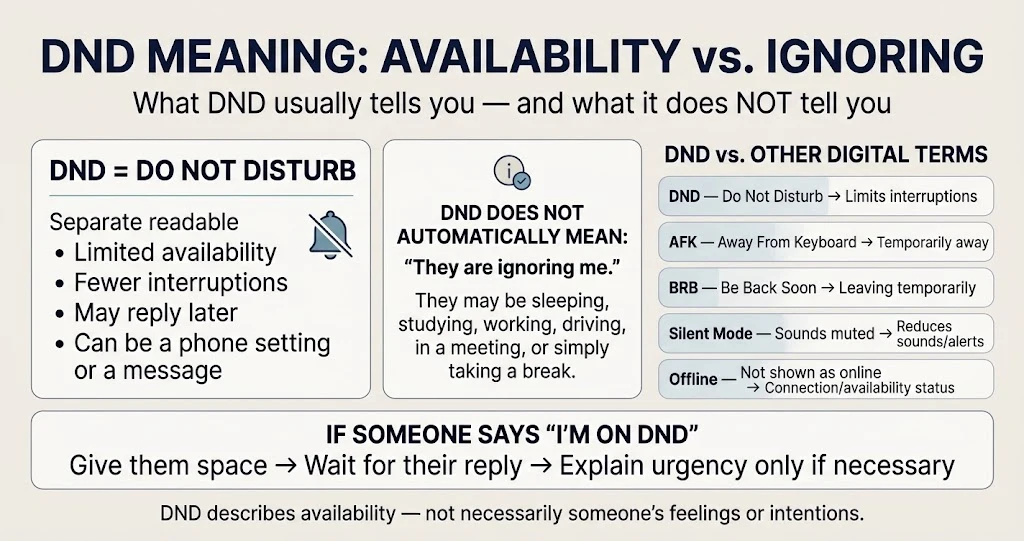
Understanding the DND meaning becomes easier when you compare it with other common digital terms.
| Term | Meaning | Main idea |
|---|---|---|
| DND | Do Not Disturb | Limits interruptions or indicates limited availability |
| AFK | Away From Keyboard | Indicates that someone has temporarily stepped away |
| BRB | Be Right Back | Shows that someone plans to return shortly |
| Silent Mode | Sounds or notifications are muted | Reduces sounds or alerts |
| Offline | Not shown as online or connected | Indicates a connection or availability status |
These terms can overlap in everyday communication.
For example, someone can use DND while actively using a phone. Another person can appear online while limiting notifications.
The surrounding message therefore provides useful clues about what someone actually means.
When Does DND Mean Dungeons & Dragons?
The DND meaning changes when the conversation focuses on gaming. In that context, DND commonly means Dungeons & Dragons, the tabletop role-playing game.
You might see examples such as:
“We’re playing DND tonight.”
“Our DND campaign starts this weekend.”
“I need a new character for my DND game.”
“Have you played DND before?”
Words such as campaign, character, dice, dungeon, party, DM, and role-playing strongly suggest the gaming meaning.
By contrast, a message such as:
“I’m on DND right now.”
usually points to Do Not Disturb.
How Can You Tell Which DND Meaning Is Intended?
Start by looking at the subject of the conversation.
If the discussion includes messages, notifications, calls, availability, or being busy, DND probably means Do Not Disturb.
When the conversation includes campaigns, characters, dice, dungeons, or role-playing, DND probably means Dungeons & Dragons.
Still unsure? Ask the person what they mean instead of making an assumption.
Frequently Asked Questions About DND Meaning
What Does DND Stand For?
DND most commonly stands for “Do Not Disturb.” In gaming contexts, DND can also refer to Dungeons & Dragons.
What Does DND Mean in a Text Message?
The DND meaning in a text message usually refers to “Do Not Disturb.” It can indicate that someone has limited availability, wants fewer interruptions, or may respond later.
Is DND a Slang Word?
DND generally functions as an abbreviation or initialism rather than traditional slang. Digital communication commonly uses it as a shortened form of “Do Not Disturb.”
Can Someone Still Receive Messages While Using DND?
That depends on the device, application, and selected settings. Do Not Disturb generally manages interruptions and notifications rather than stopping messages from reaching the device.
Is DND the Same as Silent Mode?
No. The two features can produce similar results, but they do not necessarily work in the same way.
Silent Mode generally reduces or disables sounds. Do Not Disturb can offer broader controls for calls, alerts, and notifications.
What Does DND Mean in Gaming?
In gaming, DND commonly means Dungeons & Dragons. References to campaigns, characters, dice, dungeons, or role-playing usually make this meaning clear.
Does DND Mean Someone Does Not Want to Talk to You?
Not necessarily. DND usually indicates that someone wants fewer interruptions or has limited availability. It does not automatically mean that the person feels upset with you.
What Does “I’m on DND” Mean?
“I’m on DND” usually means “I’m on Do Not Disturb.” The person is telling you that they may not respond immediately or that they want some uninterrupted time.
Conclusion
The most common DND meaning in texting and everyday digital communication is “Do Not Disturb.” People use DND to indicate limited availability, reduce interruptions, or explain why they may respond later.
The abbreviation can also mean Dungeons & Dragons when people discuss gaming. Looking at the surrounding words and topic usually reveals which meaning the speaker intends.
If you see DND in a message, do not automatically assume that the sender is ignoring you or feels upset. In most everyday situations, DND simply communicates that the person does not want interruptions or may not be available right now.
For readers who want to explore the gaming meaning further, the official Dungeons & Dragons website provides information about the game, characters, campaigns, and other D&D resources. This can help clarify the difference between DND as Do Not Disturb and DND as Dungeons & Dragons.