

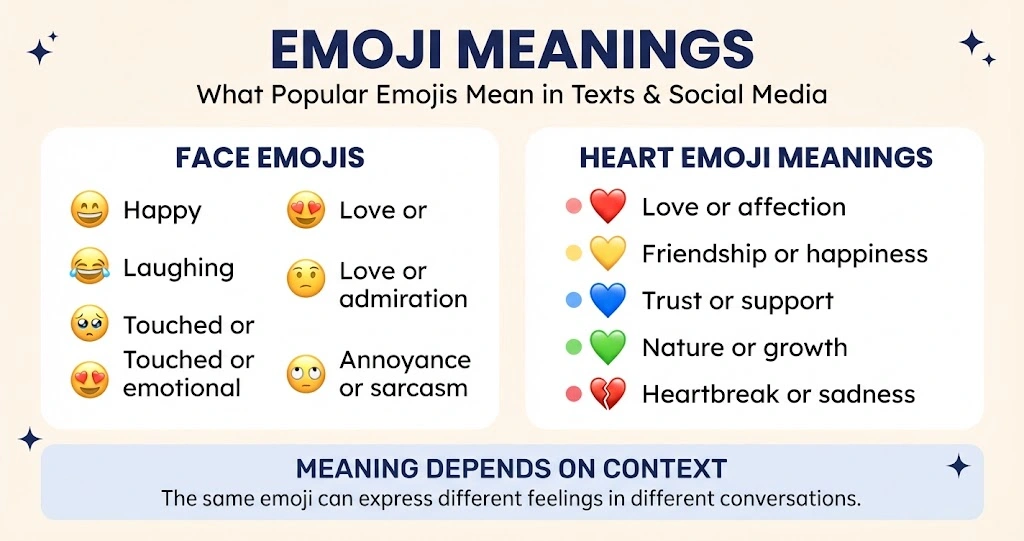
Emoji meanings can help you understand what someone is trying to express in a text message, social media comment, or online conversation. A smiling face might show happiness, a heart can communicate affection, and a laughing emoji may express amusement or embarrassment depending on the situation.
However, not every emoji has one fixed meaning. The same symbol can communicate different feelings depending on the conversation, your relationship with the sender, and the platform where you see it.
This guide explains popular emoji meanings, including emoji face meanings, heart emoji meanings, Snapchat emoji meanings, and symbols commonly used for love and happy birthday messages. You will also find practical examples and emoji copy and paste options to help you choose the right symbol for your next message.
Popular Emoji Meanings at a Glance
If you want to understand an emoji quickly, start with this reference. These are common interpretations, although individual users may use the same symbols differently.
| Emoji | Common meaning |
|---|---|
| 😀 | Happiness, friendliness, or excitement |
| 😂 | Laughing hard or finding something hilarious |
| 🥹 | Feeling touched, emotional, or grateful |
| 🥰 | Love, affection, or warmth |
| 😍 | Admiration, attraction, or excitement |
| 😭 | Crying, sadness, or overwhelming laughter |
| 🥺 | A pleading expression, tenderness, or vulnerability |
| 🙄 | Annoyance, disbelief, or sarcasm |
| 🤔 | Thinking, questioning, or uncertainty |
| 😎 | Confidence, coolness, or a relaxed attitude |
| 🤗 | Warmth, support, or a virtual hug |
| ❤️ | Love, care, or deep affection |
| 💛 | Friendship, happiness, or warmth |
| 💚 | Nature, growth, or support for a cause |
| 💙 | Trust, loyalty, or calm affection |
| 💔 | Heartbreak, sadness, or disappointment |
| 🔥 | Excitement, attractiveness, or something impressive |
| ✨ | Sparkle, celebration, emphasis, or a special feeling |
| 🙏 | Prayer, gratitude, or a request |
| 🎉 | Celebration, achievement, or a special occasion |
| 💯 | Strong agreement, excellence, or authenticity |
| 👍 | Approval, agreement, or acknowledgment |
Remember: These meanings are common interpretations, not universal rules. For example, 😂 usually expresses laughter, but someone might use it to soften an awkward reply or react to an uncomfortable situation.
Emoji Face Meanings: What Common Expressions Communicate
Face emojis can make digital conversations feel more expressive, but some are easy to misunderstand. Understanding their typical use can help you interpret a message more accurately.
Happy and smiling face emojis
😀 Grinning Face: This emoji usually expresses happiness, friendliness, or excitement. Someone might use it when sharing good news or greeting a friend.
😊 Smiling Face with Smiling Eyes: This often communicates warmth, appreciation, politeness, or quiet happiness. It can make a simple message sound more friendly.
😄 Grinning Face with Smiling Eyes: This emoji suggests cheerful excitement or genuine amusement. It works well when something makes you happy.
🙂 Slightly Smiling Face: This can communicate mild happiness or politeness. Depending on the conversation, however, it may also sound restrained, awkward, or sarcastic.
Example:
“Thanks for helping me today 😊”
The smiling face makes the message feel warm and appreciative.
Laughing and crying face emojis
😂 Face with Tears of Joy: People commonly use this emoji when something is extremely funny. It can also appear in conversations about embarrassing or awkward moments.
🤣 Rolling on the Floor Laughing: This expresses intense amusement, often when something seems especially hilarious.
😭 Loudly Crying Face: This emoji can communicate genuine sadness, but many people also use it to express uncontrollable laughter, emotional overwhelm, or dramatic reactions.
🥹 Face Holding Back Tears: This often expresses gratitude, tenderness, pride, or being emotionally moved.
Example:
“You remembered my birthday 😭❤️”
Here, the crying face most likely expresses being touched or overwhelmed rather than actual sadness.
Love and affectionate face emojis
😍 Heart-Eyes: This usually shows admiration, attraction, excitement, or love for something or someone.
🥰 Smiling Face with Hearts: This expresses affection, warmth, appreciation, or feeling loved.
😘 Face Blowing a Kiss: This can communicate affection, a friendly goodbye, or a romantic kiss, depending on the relationship.
😚 Kissing Face with Closed Eyes: This often conveys tenderness, affection, or a gentle kiss.
😳 Flushed Face: This can indicate embarrassment, surprise, shyness, or feeling caught off guard.
These emojis are common in affectionate conversations, but their meaning still depends on the sender and the relationship.
Thinking, confusion, and reaction emojis
🤔 Thinking Face: This indicates that someone is considering an idea, questioning something, or expressing doubt.
🧐 Face with Monocle: This can suggest close examination, curiosity, skepticism, or playful investigation.
😕 Confused Face: This often shows uncertainty, puzzlement, or mild disappointment.
😬 Grimacing Face: This can express awkwardness, nervousness, discomfort, or an uncomfortable reaction.
🙄 Face with Rolling Eyes: This commonly communicates annoyance, disbelief, impatience, or sarcasm.
Example:
“You said the meeting starts at 6, but the email says 7 🙄”
The rolling-eyes emoji suggests frustration or disbelief about the conflicting information.
Sarcastic and potentially misleading face emojis
Some expressions depend heavily on context.
- 🙂 Slightly smiling face: May sound friendly, formal, passive-aggressive, or sarcastic.
- 💀 Skull: Often means “I’m dead” from laughter, shock, or embarrassment in informal online slang. It does not necessarily refer to literal death.
- 🤡 Clown face: Can suggest foolish behavior, self-mockery, or criticism of someone’s actions.
- 😏 Smirking face: May express confidence, teasing, flirtation, or a suggestive tone.
- 🫠 Melting face: Often communicates embarrassment, exhaustion, awkwardness, or feeling overwhelmed.
For example, “That was a great idea 🙂” could be sincere praise or sarcasm. The surrounding conversation helps determine which interpretation makes sense.
Heart Emoji Meanings: What Different Colors Can Express
Heart emoji meanings are especially popular because people use hearts to express affection, appreciation, friendship, support, and romantic interest. However, a heart’s color does not automatically reveal someone’s feelings.
Red heart ❤️
The red heart is commonly associated with love, deep affection, romance, and emotional closeness. People also use it to show appreciation for family members, close friends, and things they genuinely love.
Example: “I appreciate everything you do for me ❤️”
Pink heart 🩷
The pink heart often expresses affection, sweetness, tenderness, or a gentle form of love. It can appear in romantic conversations, friendships, and supportive messages.
Example: “You always make me smile 🩷”
Orange heart 🧡
The orange heart can communicate warmth, care, enthusiasm, and friendly affection. Some people use it when they want to express closeness without making a strongly romantic statement.
Example: “I’m always cheering for you 🧡”
Yellow heart 💛
The yellow heart is often associated with friendship, happiness, positivity, and cheerful affection.
Example: “So grateful to have you as a friend 💛”
Green heart 💚
The green heart may represent nature, growth, health, environmental interests, or affection. Its interpretation can vary significantly with the conversation.
Example: “Spending time outside makes me happy 💚🌿”
Blue heart 💙
The blue heart commonly conveys trust, loyalty, support, calmness, or friendship. It is also used to show support for particular teams, causes, or communities.
Example: “Thank you for always being there for me 💙”
Purple heart 💜
The purple heart can communicate affection, admiration, support, or a playful sense of style. Some communities also use it in specific cultural or fandom contexts.
Example: “Sending you lots of love and support 💜”
Black heart 🖤
The black heart may express dark humor, grief, emotional intensity, alternative aesthetics, or affection. It does not automatically mean that someone feels hatred or has negative intentions.
Example: “This song understands my mood 🖤”
White heart 🤍
The white heart often represents peace, sincerity, care, sympathy, or gentle affection. People may use it in supportive messages and minimalist social media captions.
Example: “Thinking of you and sending comfort 🤍”
Brown heart 🤎
The brown heart can express warmth, closeness, nature, earthy aesthetics, or personal and cultural associations.
Example: “A quiet day, good coffee, and autumn colors 🤎☕”
Broken heart 💔
The broken heart commonly communicates heartbreak, sadness, disappointment, or emotional pain. People also use it for playful disappointment.
Example: “The concert sold out before I could buy tickets 💔”
Two hearts 💕 and revolving hearts 💞
The two-hearts emoji often expresses affection, closeness, or a loving atmosphere. Revolving hearts may suggest mutual affection, a romantic mood, or excitement.
Important: Do not assume that someone has romantic feelings simply because they send a heart. Consider the relationship, their usual texting style, and the actual conversation before drawing conclusions.
Snapchat Emoji Meanings: What the Symbols Next to Friends Mean
Snapchat uses certain emojis as indicators of friendship activity and Snapstreaks. These are different from emojis that someone manually types into a chat.
The following are commonly used Snapchat Friend Emojis and indicators. Their display can vary with app settings, customizations, and product changes.
Snapchat heart emojis
💛 Yellow Heart: Traditionally indicates that you and the other person are each other’s number-one Best Friend on Snapchat.
❤️ Red Heart: Traditionally indicates that you have been each other’s number-one Best Friend for two consecutive weeks.
💕 Pink Hearts: Traditionally indicates that you have maintained that mutual number-one Best Friend status for two consecutive months.
These symbols describe Snapchat activity and friendship rankings. They do not necessarily indicate romantic love.
Snapchat face emojis
😊 Smiling Face: Traditionally indicates that the person is one of your Best Friends, but not necessarily your number-one Best Friend.
😎 Sunglasses Face: Traditionally indicates that you share a Best Friend with that person.
😬 Grimacing Face: Traditionally indicates that your number-one Best Friend is also that person’s number-one Best Friend.
😏 Smirking Face: Has traditionally indicated a particular Best Friend relationship in which you are one of their Best Friends, but they are not one of yours. Its display and availability should be checked against the current app behavior.
Other Snapchat indicators
🔥 Fire: Indicates an active Snapstreak between you and another person.
⌛ Hourglass: Warns that a Snapstreak is close to expiring.
🎂 Birthday Cake: Traditionally appears next to a friend’s name on their birthday when the relevant birthday feature is enabled.
👶 Baby Face: Has traditionally indicated a newly established Snapchat friendship.
Because Snapchat can change features and let users customize Friend Emojis, check the app’s current settings if a symbol does not match these descriptions.
Practical tip: If you see a heart next to someone’s name on Snapchat, interpret it first as a platform activity indicator rather than proof of a romantic relationship.
Which Emojis Work Best for Love, Friendship, and Happy Birthday Messages?
Choosing an emoji becomes easier when you start with the feeling you want to communicate. Instead of adding several random symbols, select one or two that fit your message.
Emojis for love and romantic messages
Common choices include:
- ❤️ Red heart — affection or romantic love.
- 🥰 Smiling face with hearts — warmth and tenderness.
- 😘 Face blowing a kiss — a kiss or affectionate goodbye.
- 😍 Heart-eyes face — admiration or excitement.
- 💋 Kiss mark — a kiss or a playful, romantic tone.
Example: “You made my day so much better 🥰❤️”
Use romantic symbols when they suit your relationship with the recipient. If you are unsure how someone will interpret them, a simple message can communicate your feelings more clearly than a string of hearts.
Emojis for friendship and appreciation
Try these options when you want to thank someone or show support:
- 💛 Yellow heart — friendship and positivity.
- 🤗 Hugging face — comfort and warmth.
- 🙌 Raised hands — excitement or celebration.
- 🫶 Heart hands — affection, appreciation, or support.
- 😊 Smiling face — friendliness and gratitude.
Example: “Thanks for always supporting me. I’m lucky to have you as a friend 💛🫶”
Happy birthday emojis
Birthday messages often use celebration symbols to make a greeting feel cheerful and personal.
- 🎂 Birthday cake — birthday celebrations.
- 🎉 Party popper — celebration and excitement.
- 🎈 Balloon — a festive occasion.
- 🎁 Wrapped gift — presents and surprises.
- 🥳 Partying face — excitement and celebration.
- ✨ Sparkles — a special moment or celebratory emphasis.
Example birthday message:
“Happy birthday! 🎂🎉 Wishing you a wonderful year filled with happiness, success, and beautiful memories ✨💛”
For a close friend, you might use a playful combination such as 🥳🎈🎁. For a romantic partner, ❤️🥰🎂 may feel more appropriate.
The best birthday emoji is the one that matches the tone of your message and your relationship with the person.
Emoji Copy and Paste: Find and Use the Right Symbol
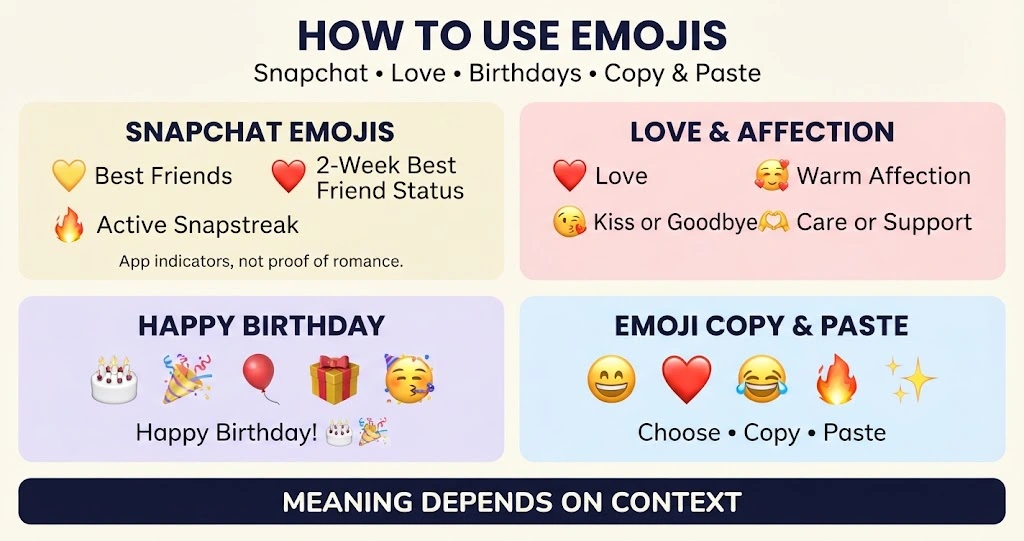
If you already know which emoji you want, you can copy it directly from a reference list or insert it using your device’s emoji keyboard.
Here are some useful combinations to copy:
Happy and positive
😀 😄 😊 🥳 ✨ 🎉
Love and affection
❤️ 🩷 🥰 😍 😘 🫶
Friendship and support
💛 💙 🤗 🙌 💐
Sadness and emotional reactions
😢 😭 🥹 💔 🫠
Thinking and confusion
🤔 🧐 😕 😬 🙄
Birthday celebrations
🎂 🎉 🎈 🎁 🥳 ✨
Everyday reactions
👍 👏 🙏 💯 🔥 💀
How to copy and paste an emoji
- Find the emoji you want in the list.
- Select the symbol and copy it using your device’s usual copy command.
- Open the message, caption, comment, or document where you want to use it.
- Paste the emoji into the text.
- Read the full message before sending to make sure the symbol communicates the intended tone.
You can also open your phone’s or computer’s emoji keyboard and search for an emoji by name or description.
Keep in mind: Some platforms display emojis differently. A symbol may look slightly different on Android, iPhone, Windows, or a social media app. Less common emojis may also be unsupported on older devices.
How to Interpret an Emoji When the Meaning Is Unclear
Sometimes an emoji seems confusing because its meaning depends on the situation. Rather than guessing immediately, use these practical checks.
1. Read the entire message
Look at the words before and after the emoji. A laughing face after a joke probably indicates amusement, while the same face after a serious complaint may express discomfort or nervous laughter.
2. Consider your relationship
A red heart from a romantic partner may communicate affection, while the same heart from a family member or friend may simply show love and appreciation.
3. Look at the conversation’s tone
Ask whether the conversation is playful, serious, emotional, sarcastic, or supportive. Emojis often reinforce the existing tone instead of creating a completely new meaning.
4. Separate platform indicators from personal messages
An emoji beside a Snapchat username may represent a friendship status or app activity. An identical symbol typed into a private message may have a completely different purpose.
5. Avoid assuming a hidden meaning
Internet slang changes, and people develop personal habits when using emojis. A skull might mean laughter, a slightly smiling face might be sarcastic, and a heart might express friendship rather than romance.
If the interpretation genuinely matters, asking a simple question is often more reliable than trying to decode the symbol alone.
For example: “I wasn’t sure how to read that emoji. What did you mean by it?”
This approach helps prevent misunderstandings without turning an ordinary conversation into an argument.
Frequently Asked Questions About Emoji Meanings
Do emojis have official meanings?
Many emojis have standardized names and descriptions, but their everyday meanings can differ. Unicode standardizes emoji characters, while people and online communities develop additional meanings through use.
Can one emoji have two different meanings?
Yes. A crying face may express sadness or laughter, while a skull can communicate shock, embarrassment, or amusement. The surrounding conversation usually provides important clues.
What is the difference between an emoji and an emoticon?
An emoji is a pictorial character, such as 😀 or ❤️. An emoticon is a text-based expression made with characters, such as 🙂 or :-(. Both can communicate emotion in digital messages.
Do heart emojis always mean romantic love?
No. Hearts can express friendship, family affection, gratitude, support, admiration, or romance. The color may suggest a particular tone, but it cannot establish someone’s feelings on its own.
Why do emojis look different on different devices?
Platforms use their own emoji artwork and rendering systems. The same standardized character can therefore look slightly different on an iPhone, Android device, computer, or social media app.
How can I find the meaning of an unfamiliar emoji?
Look at the symbol’s official name or a reliable emoji reference, then consider the conversation in which it appeared. For platform-specific symbols, consult the relevant app’s current help information.
Which emojis are best for everyday texting?
Smiling faces, hearts, thumbs-up symbols, laughter, and celebration emojis are widely used. Choose one that matches your intended tone rather than adding symbols that might confuse the recipient.
Conclusion
Understanding emoji meanings makes texting and social media conversations easier to navigate. Common face emojis express reactions and emotions, heart colors can communicate different forms of affection, and Snapchat Friend Emojis may indicate specific activity or friendship statuses within the app.
The most important point is that an emoji’s meaning depends on both the symbol and the context. A heart does not automatically mean romance, and a smiling face does not always mean happiness. Read the surrounding message, consider your relationship with the sender, and remember that people use emojis in different ways.
When you want to express yourself, choose symbols that match your message. Whether you are sending a loving note, writing a happy birthday greeting, or using emoji copy and paste for a social media caption, the right emoji can add personality and emotion without replacing clear communication.
For a more detailed reference, visit Emojipedia, where you can explore emoji names, meanings, and variations across platforms. Checking a trusted emoji reference can help you understand unfamiliar symbols and choose the right emoji for your messages, captions, and social media posts.
[…] can change the entire tone of a message. To explore this further, check out our complete guide on emoji meanings and how they shape digital […]